THE cable was not laid on the seabed to listen to whales. It was laid to carry messages between people.
The whales were not consulted, though they had been using the Arctic long before anyone thought of running fibre through it.
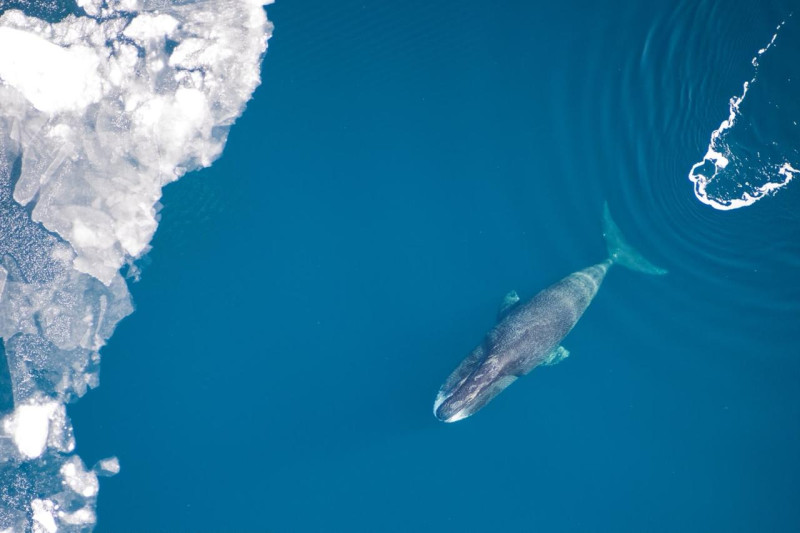
In spring 2026, researchers near Utqiaġvik, on Alaska’s North Slope, detected bowhead whale calls in the tiny vibrations of an existing cable.
An instrument at the shore end sent laser pulses through the fibre and measured minute changes in the returning signal. Sound in the water had nudged the cable. The instrument picked up the trace.
A cable does not hear by itself. The equipment turns it into something like a long line of listening points spread across the seabed.
Earlier experiments had detected blue and fin whales this way. The new result was the first detection of bowhead calls in this kind of data.
Bowheads call at higher frequencies and lower intensity, making them harder to pick up.
It is an unexpectedly good second job for infrastructure usually discussed in connection with internet outages, data centres and geopolitical vulnerability.
The method is called distributed acoustic sensing. The name is less interesting than the image: a line built to connect one human place to another becoming a way to notice what is happening in the water below it.
Some existing fibre can be used, with specialised equipment on shore. The cable itself does not need to be rebuilt as a network of underwater microphones.
For scientists, the method could help fill some of the gaps in how we monitor whales. Their calls can offer clues about where the animals are, when they migrate and how they respond to a changing Arctic.
The Utqiaġvik fieldwork involved local whaling and wildlife organisations, researchers and the telecommunications company that owns the cable. That mix matters.
The technology may be clever; making it useful depends on access, local knowledge and careful interpretation.
There is a practical lesson here. New environmental monitoring does not always require a new instrument on every patch of ocean. Sometimes a useful sensor is already there, doing another job.
The technology will not replace traditional hydrophones, and not every cable is suited to the task. Researchers still have to work through vast amounts of data and establish what different cables can reliably detect. But the approach could give them a much wider view than a few instruments deployed from a ship.
The more interesting question begins after the detection. We know a call is there. We may be able to locate it, distinguish it, follow its pattern. We do not know what it means to the whale making it.
A trace in a fibre is evidence of a voice, not access to another animal’s inner life.
The equipment can make a signal visible. It cannot decide what attention that signal deserves. The cable can register a whale; it cannot decide whether a ship should slow down, whether a migration route needs protection, or who should have access to the information. Those decisions still belong to people.
There is something quietly humbling in the arrangement. We laid a line across the seabed to make human communication faster and more reliable. Now the same line may help us notice a life that was there all along, calling in a register our equipment had not yet learned to detect.
The ocean was never silent. Our listening was sparse and expensive. A cable may change that. What happens to the information after it reaches the shore is still an open question. – November 14, 2026
Pascal H. Grégoire is a career diplomat and essayist who served as Belgium's Ambassador to Malaysia from 2018 to 2022. He is the editor of Contre-Jour and currently the ambassador of Belgium to the Kingdom of Saudi Arabia.