SUVA – Fijians were warned today that no part of the Pacific island nation will escape the wrath of approaching super cyclone Yasa, expected to bring flash floods, huge waves and widespread destruction.
Prime Minister Frank Bainimarama blamed the unfolding emergency on climate change and told islanders that the storm could be worse than a cyclone four years ago that killed dozens.
The top-of-the-scale category five storm continued to gather strength as it rumbled toward Fiji, with wind gusts reaching 325 km ph.
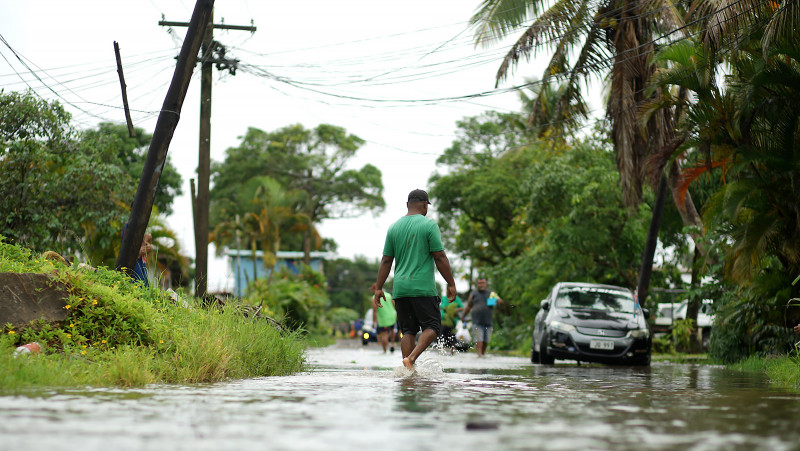
Yasa was forecast to make landfall late today but its outer bands were already bringing heavy rain and strong winds, causing widespread flooding, cutting off roads and leaving communities isolated.
Bainimarama said the approaching storm was so big that its impact was likely to be felt across the entire country, not just in localised areas.
“Over 850,000 Fijians are in the direct path of the cyclone – more than 95% of our population,” he said.
“Everywhere in Fiji, we can expect the rains will get worse, the winds will become more destructive.
“In low-lying areas, we anticipate flash flooding and severe coastal inundation, including waves up to 10m in height."
He said Yasa “could easily surpass” the destruction wrought by Cyclone Winston in February 2016, which killed 44 people and destroyed tens of thousands of homes.
The Fijian leader, a long-time campaigner for climate action, had no doubt global warming was fuelling such super storms, which were once rare but have become relatively common.
“As the world is getting warmer these storms are getting stronger,” he said.
“Every one of us must treat these climate-fuelled catastrophes with deadly seriousness.”
Lessons learned
Fiji has opened evacuation centres and people living near the coast have been advised to flee to higher ground.
Housing in Fiji’s villages is largely made from timber and corrugated iron, making them vulnerable to high winds.
Sheltering in schools, church halls and even shipping containers offers better protection but runs the risk of health issues if people stay longer than a few days.
All schools and public transport were closed, with non-essential public servants told to stay home and a curfew in place for tonight.
“We don’t want anybody losing their lives out there,” assistant police commissioner Abdul Khan said.
“We will be here to protect you. Please take this seriously and let us prepare for a worst-case scenario.”
The warnings were being heeded in Suva, where the downtown area was virtually abandoned this morning as residents hunkered down.
“It’s like a ghost town. There’ll be no business here today,” one office worker said.
“It’s calm now, but it’s scary because we know it is coming.”
New Zealand-based meteorological service Weatherwatch said Yasa was one of the most powerful cyclones recorded in the South Pacific, capable of cutting a swathe of destruction 300km wide.
“This storm has the ability to swamp entire islands, inundate entire coastal communities, wipe some small islands off the map entirely,” Weatherwatch managing director Philip Duncan said.
Save the Children said lessons had been learned from Winston in 2016 and Fijians were taking cyclone preparation seriously.
“We’ve seen people stocking up on essential food items and supplies,” the aid agency’s Fiji chief Shairana Ali said.
“People are stocking up on water because there is a warning from the Fiji Water Authority that people will not have proper water supply for at least 10 days.”
Ali said Yasa was expected to make landfall late today at Bua province, on the island of Vanua Levu, although the cyclone’s track has been difficult to accurately predict.
Fiji’s borders remain closed due to the coronavirus pandemic, which Ali said could present a challenge for international relief efforts.
Aid agencies have pre-positioned supplies across the country in anticipation of a major disaster during cyclone season, which runs until May next year.
The most recent category five storm to hit Fiji was the highly destructive Cyclone Harold in April this year. – AFP, December 17, 2020