


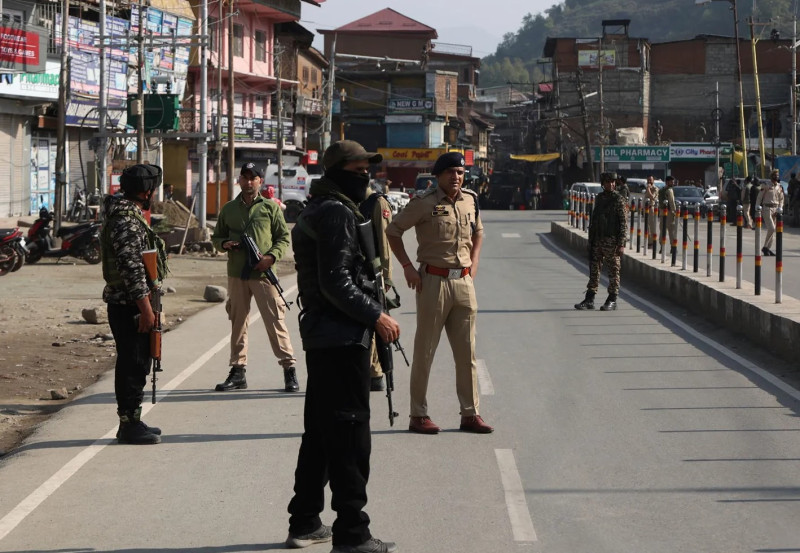
THE U.S. State Department said on Sunday, Washington was in touch with both India and Pakistan while urging them to work towards what it called a "responsible solution" as tensions have risen between the two Asian nations following a recent Islamist militant attack in Kashmir.
Reuters reported today that, in public, the U.S. government has expressed support for India after the attack but has not criticized Pakistan. India blamed Pakistan for the April 22 attack in Indian-administered Kashmir that killed over two dozen people. Pakistan denies responsibility and called for a neutral probe.
"This is an evolving situation and we are monitoring developments closely. We have been in touch with the governments of India and Pakistan at multiple levels," a U.S. State Department spokesperson told Reuters in an emailed statement.
"The United States encourages all parties to work together towards a responsible resolution," the spokesperson added.
The State Department spokesperson also said Washington "stands with India and strongly condemns the terrorist attack in Pahalgam," reiterating comments similar to recent ones made by President Donald Trump and Vice President JD Vance.
India is an increasingly important U.S. partner as Washington aims to counter China's rising influence in Asia while Pakistan remains a U.S. ally even as its importance for Washington has diminished after the 2021 U.S. withdrawal from neighboring Afghanistan.
Michael Kugelman, a Washington-based South Asia analyst and writer for the Foreign Policy magazine, said India is now a much closer U.S. partner than Pakistan.
"This may worry Islamabad that if India retaliates militarily, the U.S. may sympathize with its counter-terrorism imperatives and not try to stand in the way," Kugelman told Reuters.
Kugelman also said that given Washington's involvement and ongoing diplomatic efforts in Russia's war in Ukraine and Israel's war in Gaza, the Trump administration is "dealing with a lot on its global plate" and may leave India and Pakistan on their own, at least in the early days of the tensions.
Hussain Haqqani, a former Pakistan ambassador to the U.S. and a senior fellow at the Hudson Institute think tank, also said that there seemed to be no U.S. appetite to calm the situation at this moment.
"India has a longstanding grievance about terrorism emanating or supported from across border. Pakistan has a longstanding belief that India wants to dismember it. Both work themselves into a frenzy every few years. This time there is no U.S. interest in calming things down," Haqqani said.
Escalating Tensions
Muslim-majority Kashmir is claimed in full by both Hindu-majority India and Islamic Pakistan who each rule over only parts of it and have previously fought wars over the Himalayan region.
Hindu nationalist Indian Prime Minister Narendra Modi has vowed to pursue the attackers to "the ends of the earth" and said that those who planned and carried out the Kashmir attack "will be punished beyond their imagination". Calls have also grown from Indian politicians and others for military action against Pakistan.
After the attack, India and Pakistan unleashed a raft of measures against each other, with Pakistan closing its airspace to Indian airlines and India suspending the 1960 Indus Waters Treaty that regulates water-sharing from the Indus River and its tributaries.
The two sides have also exchanged fire across their de facto border after four years of relative calm.
A little-known militant group, Kashmir Resistance, claimed responsibility for the attack in a social media message. Indian security agencies say Kashmir Resistance, also known as The Resistance Front, is a front for Pakistan-based militant organizations such as Lashkar-e-Taiba and Hizbul Mujahideen.
Ned Price, a former U.S. State Department official under the administration of former President Joe Biden, said that while the Trump administration was giving this issue the sensitivity it deserves, a perception that it would back India at any cost may escalate tensions further.
"The Trump Administration has made clear it wishes to deepen the U.S.-India partnership — a laudable goal — but that it is willing to do so at almost any cost. If India feels that the Trump Administration will back it to the hilt no matter what, we could be in store for more escalation and more violence between these nuclear-armed neighbors," Price said. - April 28, 2025










