WASHINGTON – US President Donald Trump vetoed a broad defence funding bill sent to him by Congress yesterday, complaining that it helps Russia and China and objecting to provisions to rename military bases.
The bipartisan bill was passed by high enough margins in both chambers of Congress for lawmakers to – in theory – override the president’s rejection.
The veto of the US$740 billion (RM3 trillion) measure to fund the military for fiscal 2021 came a day after the US leader, with less than a month left in office, threw a separate US$900 billion (RM3.65 trillion) Covid-19 relief bill and overall funding for the government into question.
Trump criticised the annual National Defence Authorisation Act (NDAA) for not responding to his demand to end liability protections for social media companies, known as Section 230 – an issue with no relationship to the US Defence Department.
He also objected to a provision in the NDAA to rename military bases bearing the names of generals from the secessionist, slavery-supporting south in the 19th-century US civil war, as well as to a provision that can impede his decision to sharply cut US troop levels in Germany, Afghanistan and elsewhere.
The NDAA “fails to include critical national security measures, includes provisions that fail to respect our veterans and our military’s history, and contradicts efforts by my administration to put America first in our national security and foreign policy actions,” Trump said in a statement.
Without the changes to Section 230, Trump said, the NDAA “is a ‘gift’ to China and Russia”.
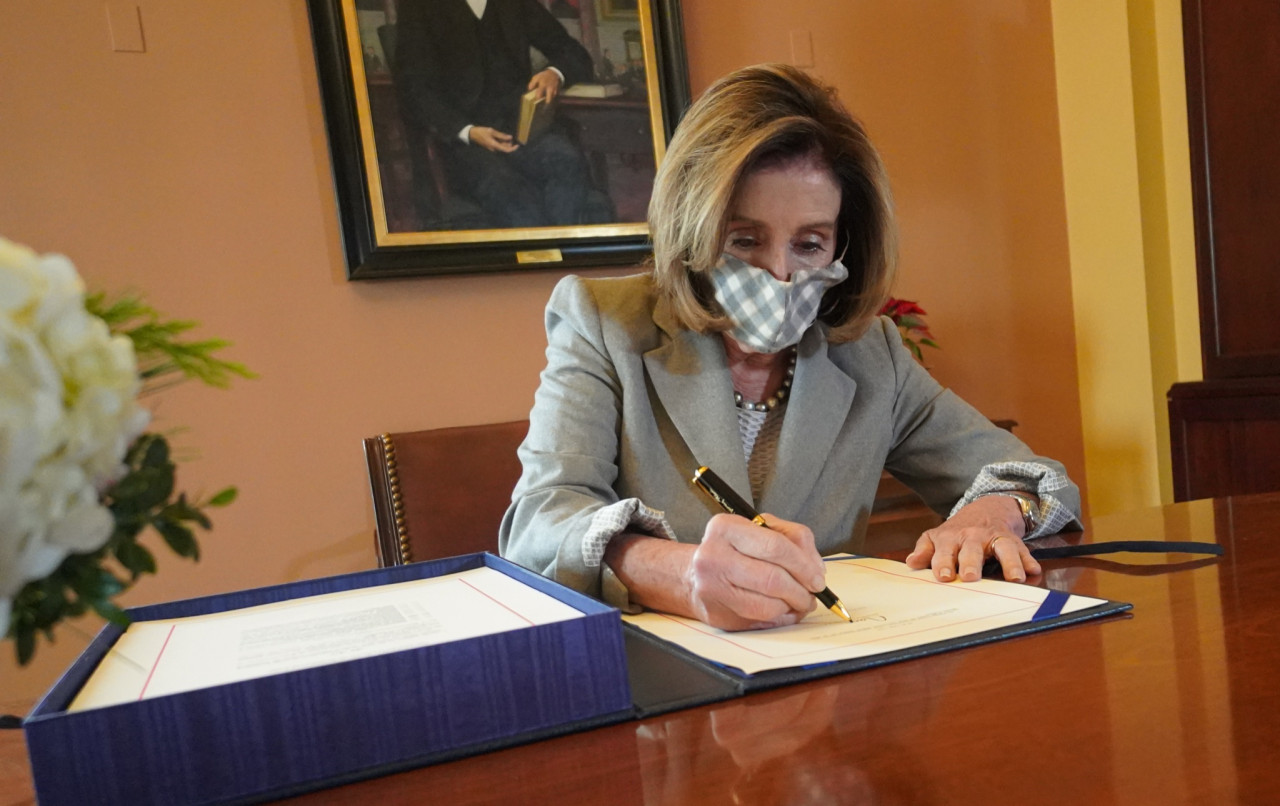
Democratic House Speaker Nancy Pelosi has slammed Trump’s veto as “an act of recklessness that harms our troops, endangers our security and undermines the will of Congress”.
Both the House and Senate have set aside time next week to vote to override the veto – which would be the first such rebuff from Congress in Trump’s nearly four years in office.
But with the omnibus funding bill, including general government finance and Covid-19 relief, still up in the air, it is not clear whether Trump is leveraging both for concessions.
“I will not approve this bill, which would put the interests of the Washington, DC establishment over those of the American people,” Trump said.
Trump has repeatedly demanded that the NDAA include changes to Section 230, a part of US communications legislation that protects social media giants like Facebook and Twitter from responsibility for content posted by their users.
Since early this year, Trump has become angered by social media for removing factually incorrect posts or posting warning labels on them, especially about the coronavirus pandemic.
But Trump said changing Section 230 was an issue of national security.
“Your failure to terminate the very dangerous national security risk of Section 230 will make our intelligence virtually impossible to conduct without everyone knowing what we are doing at every step,” he said in the statement.
He called the move to change base names – which is supported generally in the Pentagon – “politically motivated”, making no mention of the legacy of racism and slavery carried by the names.
The veto does not immediately choke off funds to the Pentagon, but if the NDAA isn’t passed soon, funding could be tightened.
“The NDAA has become law every year for 59 years straight because it’s absolutely vital to our national security and our troops,” said Republican Senator Jim Inhofe.
“This year must not be an exception. Our men and women who volunteer to wear the uniform shouldn’t be denied what they need – ever.”
Added Liz Cheney, a member of the House Republican leadership: “Congress must uphold its highest responsibility – providing for the defence of this nation – and ensure this bill becomes law.” – AFP, December 24, 2020