


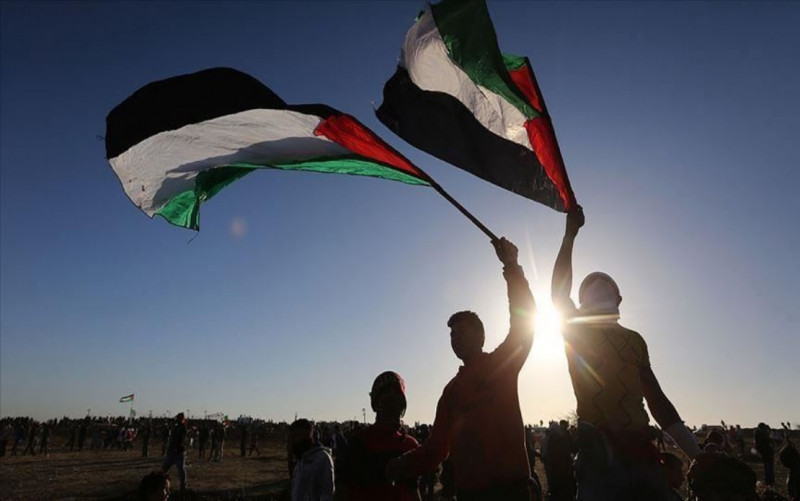
BRITAIN, Australia, Canada and Portugal have officially recognised the State of Palestine, a historic development that signals a major shift in Western foreign policy and has drawn fierce condemnation from the Israeli government.
The move was met with celebrations in the Gaza Strip, where Palestinians view the recognitions as a diplomatic victory after nearly two years of relentless conflict and humanitarian devastation.
AFP reported Israeli Prime Minister Benjamin Netanyahu responded with outright rejection, declaring, “This is an absurd action that endangers the existence of Israel. It will not happen. No Palestinian state will be established west of the Jordan River.”
He further pledged to expand illegal Israeli settlements in the occupied West Bank, which Israel has controlled since 1967.
The coordinated announcements came just days before the United Nations General Assembly (UNGA) in New York, where additional recognitions are anticipated. Countries including France, Belgium, Luxembourg and Malta are expected to follow suit during a summit focused on the future of the two-state solution, co-chaired by France and Saudi Arabia.
Britain and Canada are now the first G7 members to formally recognise Palestinian statehood. British Prime Minister Keir Starmer stated, “Britain formally recognises the State of Palestine to rekindle the hope of peace for Palestinians and Israelis, through a two-state solution.”
The decision underscores growing global discontent with Israel’s military campaign in Gaza, which began in October 2023 following an attack by Hamas.
The ongoing conflict has triggered what many describe as the worst humanitarian crisis the territory has ever faced.
According to an AFP tally, at least 144 of the 193 United Nations member states now recognise Palestine as a state.
The figure includes the latest recognitions by the UK, Canada and Australia. Portugal is the latest to join the list, and confirmation from several African nations is pending. Russia, all Arab countries, most African and Latin American nations, as well as major Asian powers such as India and China, have long extended recognition.
Algeria was the first to do so, minutes after the Palestine Liberation Organisation (PLO) under Yasser Arafat unilaterally declared statehood on 15 November 1988. A wave of recognitions followed shortly thereafter, with another surge occurring between late 2010 and early 2011.
The war in Gaza has further catalysed change. Twelve more countries have granted recognition since the Hamas attack on 7 October 2023 and Israel's subsequent offensive.
At least 46 countries do not recognise Palestine. These include Israel, the United States, Japan, South Korea, Singapore, Cameroon, Panama, and most nations in Oceania.
Europe remains deeply divided: while Sweden recognised Palestine in 2014, the rest of Western and Northern Europe had long withheld recognition—until 2024, when Norway, Spain, Ireland and Slovenia broke rank. Italy and Germany have confirmed they do not plan to follow suit.
Romain Le Boeuf, professor of international law at the University of Aix-Marseille, told AFP that recognising Palestinian statehood remains “one of the most complicated questions” in international law, calling it “a halfway point between the political and juridical.”
He explained that there is no formal mechanism for registering state recognitions. “The Palestinian Authority in the West Bank puts all they consider to be acts of recognition on its own list, but from a purely subjective point of view. In the same way, other states will say that they have or have not recognised, but without really having to justify themselves,” he said.
He noted that international law is clear on one point: “Recognition does not mean that a state has been created, no more than the lack of recognition prevents the state from existing.”
While largely symbolic, recognition carries significant political weight. “Three-quarters of countries say that Palestine meets all the necessary conditions to be a state,” said Le Boeuf.
Franco-British lawyer and professor Philippe Sands wrote in the *New York Times* in August 2025, “I know for many people this seems only symbolic, but actually in terms of symbolism, it is sort of a game changer. Because once you recognise Palestinian statehood... you essentially put Palestine and Israel on level footing in terms of their treatment under international law.”- September 22, 2025










