


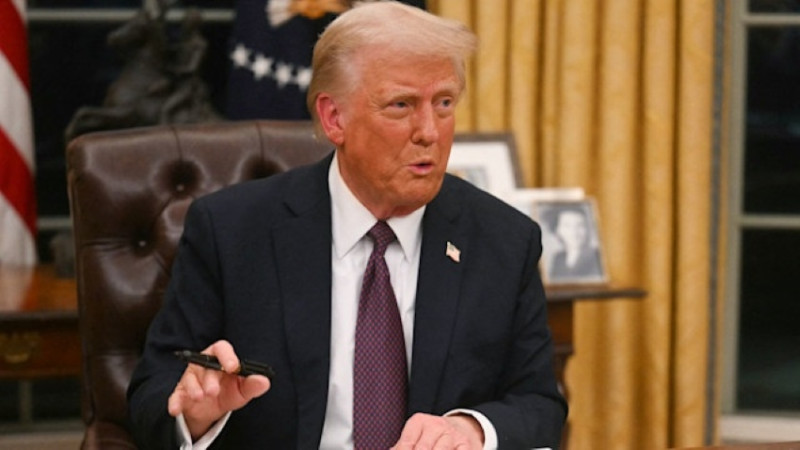
WITH a stroke of his trademark black pen, U.S. President Donald Trump has signed what is expected to become his 221st executive order since returning to office in January, eclipsing the total he issued during his entire first term and marking one of the most aggressive assertions of presidential power in modern US history.
According to an AFP analysis, Trump’s use of executive orders now exceeds that of every recent president and stands unmatched since World War II. His latest order, signed yesterday, classifies fentanyl as “a weapon of mass destruction”.
A total of 220 legally binding executive orders have already been published in the Federal Register, which confirmed the updated figure today. Executive orders do not require approval from Congress.
The number far outstrips the pace set by Trump’s predecessors Joe Biden, Barack Obama and George W. Bush, who signed an average of 30 to 40 executive orders a year.
Only Franklin D. Roosevelt, who issued nearly 4,000 orders over four terms between 1933 and 1945 during the Great Depression and World War II, governed at a comparable rate.
Trump, who returned to the White House on January 20, has relied heavily on executive authority despite holding a congressional majority.
“These orders are a part of a communications strategy,” said John Woolley, professor of political science at the University of California, Santa Barbara.
“It’s a way of signalling to important constituent groups that he is advancing ‘the cause’,” said Woolley, who is also co-director of the American Presidency Project.
An analysis of official government data shows that nearly 60 per cent of Trump’s executive orders address domestic issues, while fewer than 10 per cent focus exclusively on foreign policy.
The remainder cover a wide range of administrative and miscellaneous matters.
Social policy dominates his agenda, accounting for about 30 per cent of all orders, ahead of trade, the economy and investment at around 20 per cent, and government reform at approximately 18 per cent.
Immigration and security, a central theme of Trump’s 2024 campaign, represent about 10 per cent.
Several orders explicitly reflect ideological positions. A July 23 directive calls for artificial intelligence systems to ban models that give attention to diversity and inclusion concerns, underscoring the administration’s campaign against “woke” culture.
Another order dated August 28 mandates that “classical and traditional architecture” be the preferred style for federal buildings.
However, the effectiveness of governing by executive order has been questioned, with many directives challenged in court.
According to the independent legal website Just Security, just over one fifth of Trump’s orders have faced legal action, with more than 20 blocked at least partially or provisionally.
In late August, a federal appeals court ruled that large portions of Trump’s new customs duties were illegal.
The Supreme Court, reshaped by Trump-appointed justices during his first term, appeared sceptical of the legal basis for many of the tariffs during a November 5 hearing.
Trump remains undeterred.
“He is not afraid of being attacked about the substance of the orders,” Woolley said.
“He is deliberately testing the limits of the law.”
“His bet is that on most of the big issues, the Supreme Court will agree with a lot of his view of executive power.”
An AFP review of Trump’s executive orders also highlights a distinctive and combative tone. He uses the verb “impose” five times more frequently than his three immediate predecessors and refers to the “nation” and the “American people” significantly more often, underscoring a strongly patriotic framing.
More than 15 per cent of the orders can be characterised as acts of political retribution, frequently criticising the previous administration and accusing it of failures such as allowing millions of illegal immigrants into the country.
“No prior president issued orders explicitly attacking his critics and prior opponents,” Woolley said.
In November, Trump declared that all executive orders and documents signed using an autopen under Biden were “terminated”, a claim rejected by Biden and unsupported by legal precedent. - December 18, 2025










