


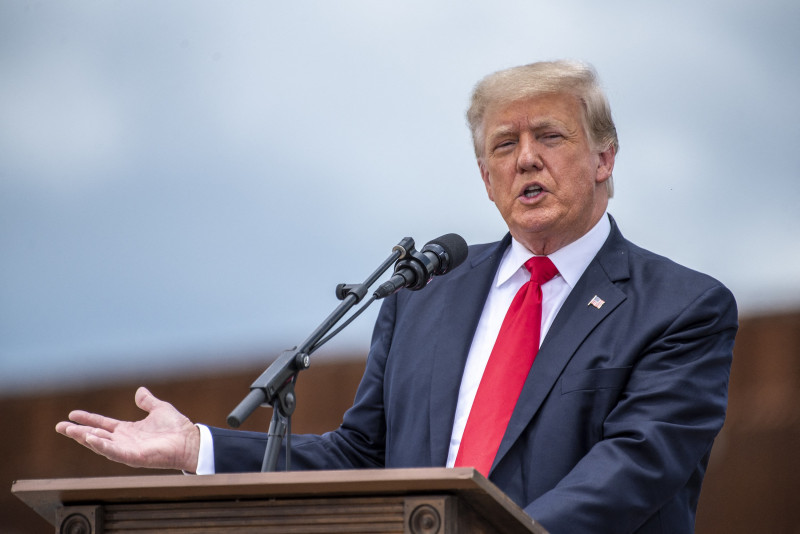
U.S. President Donald Trump has dramatically eased his recent threats to impose tariffs on European nations as leverage to acquire Greenland, indicating that a negotiated solution may be within reach over the strategically vital Danish territory.
Speaking from the World Economic Forum in Davos, Reuters, on Thursday, reported that Trump ruled out the use of military force, proposing instead that Western allies could reach a long-term arrangement addressing his ambitions for missile-defence installations and access to critical Arctic minerals, while countering the growing influence of Russia and China in the region.
“It’s a deal that everybody’s very happy with,” Trump told reporters. “It’s a long-term deal. It’s the ultimate long-term deal. It puts everybody in a really good position, especially as it pertains to security and to minerals. It’s a deal that’s forever.”
The shift in tone followed discussions with NATO Secretary General Mark Rutte, who confirmed that the question of Greenland’s sovereignty did not arise in their meetings.
“That issue did not come up anymore in my conversations tonight with the president,” Rutte said in an interview, emphasising that Trump’s focus remains on safeguarding the Arctic from increasing Chinese and Russian activity.
Earlier on Wednesday, Trump had issued a series of pointed warnings to European nations, raising concerns over NATO cohesion and the potential for broader trade disputes.
European diplomats noted that while the president’s reversal does not resolve the underlying territorial dispute, it serves to defuse tensions and allows negotiations to proceed behind closed doors.
Discussions involving Denmark, Greenland, and the United States are expected to continue with the objective of preventing any Russian or Chinese economic or military foothold in the territory.
Trump said he had designated Vice President JD Vance, Secretary of State Marco Rubio, and envoy Steve Witkoff to participate in further deliberations.
“People thought I would use force, but I don't have to use force,” Trump remarked. “I don't want to use force. I won't use force.” His announcement prompted a positive reaction on Wall Street, with the S&P 500 rising 1.16 per cent in the day’s trading.
Denmark’s Foreign Minister Lars Løkke Rasmussen highlighted the importance of resolving the matter with full respect for the kingdom’s integrity and the Greenlandic people’s right to self-determination.
“What is crucial for us is that we get to end this with respect for the integrity and sovereignty of the kingdom and the right of the Greenlandic people to self-determination,” he said, declining to provide further details of private discussions.
Trump’s commentary on Greenland dominated his whirlwind Davos itinerary, where he also criticised European allies on matters ranging from energy policy and trade surpluses to NATO cooperation.
While the threat of force has been removed from the table, he continued to emphasise U.S. military strength and framed his actions as defending Western interests.
Analysts view his Greenland initiative as part of a broader legacy-building effort, reminiscent of the territorial expansions that brought Alaska and Hawaii into the United States in the 20th century.
During his visit, Trump is expected to meet Ukrainian President Volodymyr Zelenskiy and seek support from global leaders for his Board of Peace initiative, even as diplomats caution that it could overlap with the work of the United Nations.
According to sources familiar with the matter, the State Department has advised U.S. diplomats that the board is not intended to replace the United Nations but rather to complement its efforts.
Originally conceived to provide oversight for a transition in the war-torn Gaza Strip under Trump’s 20-point peace plan, the Board of Peace will be chaired by the U.S. president.
Its members will convene frequently via video conferencing, though final decisions on admissions will rest with the American president, sources added.
A spokesperson for the State Department declined further comment, stating only that Trump intends to make an announcement regarding the board. - January 22, 2026










