


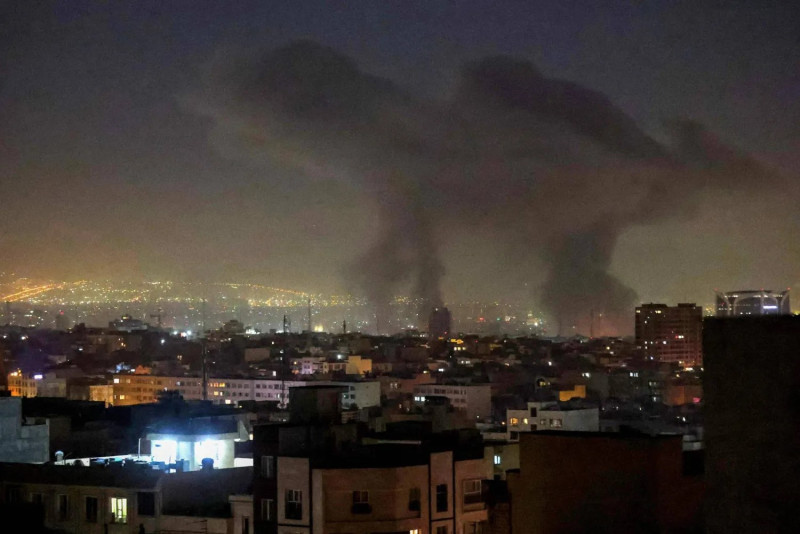
AT least 787 people have been killed in Iran by combined United States and Israeli airstrikes since the outbreak of the conflict on Saturday, the Iranian Red Crescent Society said in a message on X on Tuesday, underscoring the deadly intensity of the confrontation that shows no sign of abating.
The announcement came as Iran launched a drone attack on the United States Embassy in Riyadh, Saudi Arabia, and as US and Israeli jets carried out further strikes on targets inside Iran, according to Asharq Al-Awsat, a Arab base newspaper.
Explosions were reported across Tehran throughout the night and into the early hours of Tuesday, with witnesses describing the sound of aircraft overhead.
According to the Saudi Arabia Defence Ministry, the drone assault caused a limited fire and only minor damage at the US Embassy in the Saudi capital.
The embassy has urged American citizens to avoid the compound.
The attack followed a separate incident at the US Embassy in Kuwait, prompting Kuwaiti authorities to announce the mission’s closure until further notice.
In response to the escalating violence, the US State Department ordered the evacuation of non‑emergency personnel and family members from several Middle Eastern posts, including Kuwait, Bahrain, Iraq, Qatar, Jordan and the United Arab Emirates.
The conflict has spread beyond Iran’s borders. In Lebanon, Israel intensified strikes against Hezbollah positions, with explosions heard and smoke rising over a southern suburb of Beirut.
The Israeli military has said its forces are “operating in southern Lebanon,” and Lebanon’s state‑run National News Agency reported that the Lebanese army was pulling back some units along the border.
The widening war shows few signs of an imminent end. Iranian Supreme Leader Ali Khamenei has been killed during the campaign, and there is no evident exit strategy from either Washington or Jerusalem.
The Iranian Revolutionary Guard has struck targets in several countries it considers safe havens, including two Amazon data centres in the United Arab Emirates and a drone strike near another site in Bahrain that caused damage, the company said on Tuesday.
Energy infrastructure in Qatar and Saudi Arabia has also been hit, and Iranian forces have attacked multiple vessels in the strategic Strait of Hormuz, through which about one‑fifth of the world’s traded oil passes, contributing to rising global oil and gas prices.
“The Strait of Hormuz is closed,” Iranian Brigadier General Ebrahim Jabbari, an adviser to the Revolutionary Guard, declared, threatening to set fire to any ships attempting to transit.
The rising toll and regional escalation have spurred travel warnings around the world.
The US State Department has urged American citizens to leave more than a dozen countries in the Middle East because of safety concerns, a position echoed by other governments, although widespread airspace closures have left many travellers stranded.
US President Donald Trump suggested the campaign could be prolonged, saying operations were likely to last “four to five weeks” but that he was prepared “to go far longer than that.”
He later wrote on social media that the United States had a “virtually unlimited supply” of munitions and pre‑positioned “high grade weaponry,” adding: “Wars can be fought ‘forever,’ and very successfully, using just these supplies.”
Meanwhile, Tehran has issued stern warnings to European nations contemplating involvement.
Reacting to statements by Germany, Britain and France that they might take “defensive action” against Iran’s missile‑launching capabilities, Iran’s foreign ministry spokesman Esmaeil Baqaei said in a press briefing that any such measures “would be an act of war. Any such act against Iran would be regarded as complicity with the aggressors. It would be regarded as an act of war against Iran.” - March 3, 2026










