


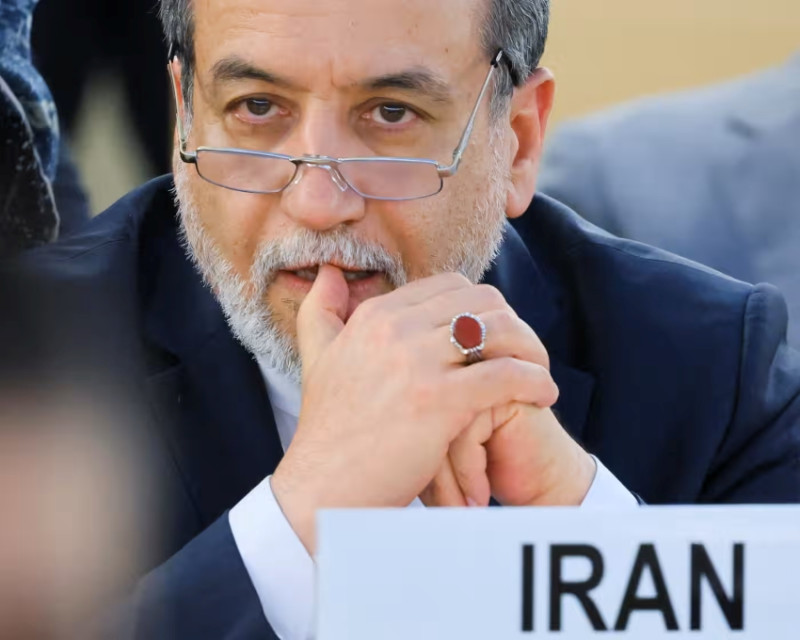
IRAN’S foreign minister has insisted that the country alone will determine its next leader, rejecting suggestions by U.S. President Donald Trump that Washington should have a say in the succession following the death of Supreme Leader Ali Khamenei.
Speaking to NBC’s Meet the Press programme, Foreign Minister Abbas Araghchi said the choice of a new leader rested solely with the Iranian people and warned against foreign interference in the country’s internal affairs.
"We do not allow anyone to interfere in our internal affairs. It is up to the Iranian people to choose their new leader," AFP reported Araghchi saying today.
Trump had earlier indicated that he believed the United States should have a role in selecting Iran’s next supreme leader after Khamenei was killed in the opening US-Israeli strike that triggered the conflict nine days ago. He also dismissed the possibility that Khamenei’s son, Mojtaba Khamenei, should succeed his father.
Araghchi declined to comment on who might ultimately replace the late supreme leader.
Iranian state media reported that the clerical body responsible for appointing the country’s supreme leader had already conducted a vote, with the new leader expected to be announced soon.
Some clerics have proposed Mojtaba Khamenei as a potential successor.
"We need to wait for the Assembly of Experts to convene and vote for the new supreme leader, and whoever they choose," Araghchi said during the NBC interview.
The foreign minister also demanded that Trump apologise for what he described as the destruction and loss of life caused by the conflict.
"Trump needs to apologise to the people of the region and to the people of Iran for the killing and destruction that they have inflicted upon us," he said.
Araghchi defended Iran’s missile strikes during the conflict that also struck parts of neighbouring Gulf states, saying the attacks were aimed at US military facilities across the region rather than civilian targets.
He argued that Iran’s response was an act of self-defence following US attacks on Iranian territory.
"America started this war against us by attacking us, and we were only defending ourselves. So it is clear that our missiles cannot reach US territory," Araghchi said.
"What we can do is attack American bases and facilities around us, which unfortunately are located in the territory of our neighbouring countries."
Trump has previously warned that Iranian missiles could soon develop the capability to strike the United States directly.
However, a US intelligence assessment in 2025 concluded that Tehran did not possess intercontinental ballistic missiles and might only be able to develop roughly 60 such weapons by 2035. - March 9, 2026










