


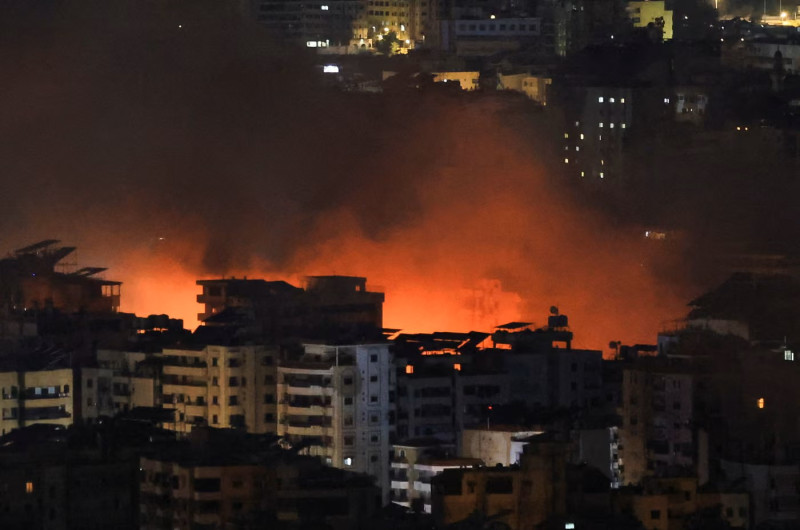
THE United States and Israel launched what both Pentagon officials and Iranian sources have described as the most intense airstrikes of the war on Tuesday, targeting multiple sites across Iran, even as financial markets speculated that President Donald Trump may seek to end the conflict soon.
Reuters reported on Wedneday that the attacks mark a dramatic escalation in the West Asia theatre, with Iran’s Islamic Revolutionary Guard Corps issuing a warning that it would block oil shipments from the Gulf unless U.S. and Israeli strikes cease.
The Revolutionary Guards reported missile launches on Qatar’s U.S.-operated Al Udeid base and the Al Harir base in Iraq’s Kurdistan, followed by drone attacks on U.S. troops at Al Dhafra air base in the UAE and the Juffair naval base in Bahrain.
Iranian state media reported further attacks on U.S. installations in Bahrain early Wednesday, alongside waves of missiles fired at central Israel, prompting air raid sirens and residents scrambling to shelters.
The strikes coincided with a fresh Israeli offensive on Beirut, aimed at Iran-backed Hezbollah positions that have fired into Israel in solidarity with Tehran.
U.S. Defence Secretary Pete Hegseth described the operations at the Pentagon briefing as “our most intense day of strikes inside Iran: the most fighters, the most bombers, the most strikes, intelligence more refined and better than ever.”
President Donald Trump posted on Truth Social that ten of Iran’s “inactive” mine-laying vessels had been “completely destroyed,” though he did not clarify the locations of the strikes.
Residents in Tehran described the bombardment as unprecedented.
“It was like hell. They were bombing everywhere, every part of Tehran,” one resident told Reuters.
“My children are afraid to sleep now.”
Two five-storey residential buildings were hit on Monday, leaving concrete frames exposed and several casualties, with recovery efforts continuing even as additional missile strikes hit nearby roads.
Despite the intensity, Trump’s prior remarks suggesting the conflict could end soon helped calm markets, which saw crude oil prices retreat from historic highs of nearly US$120 per barrel to below US$90.
Asian and European stock indices partially recovered, while Wall Street stabilised near late February levels.
White House Press Secretary Karoline Leavitt said Americans could expect oil and gas prices to drop rapidly once military objectives were achieved.
Israeli officials indicated the offensive would continue until a joint assessment with the U.S. determined hostilities should cease.
Foreign Minister Gideon Saar said Israel was not seeking an “endless war,” but would persist until the timing was deemed appropriate.
Meanwhile, Iran remains defiant, refusing to concede to U.S. demands over leadership, with hardliner Mojtaba Khamenei named as supreme leader.
Senior Iranian officials have vowed resistance. “Certainly, we are not seeking a ceasefire; we believe the aggressor must be struck in the mouth so that they learn a lesson,” Parliament Speaker Mohammad Baqer Qalibaf said.
The Revolutionary Guards confirmed that “not one litre” of Middle Eastern oil would reach the U.S. or its allies while strikes continue, asserting, “We are the ones who will determine the end of the war.”
The conflict has already caused massive civilian casualties and infrastructure damage. Iran’s U.N. ambassador Amir Saeid Iravani reported more than 1,300 civilian deaths, nearly 8,000 homes destroyed, 1,600 commercial centres damaged, and numerous medical, educational, and energy facilities affected.
Israeli strikes in Lebanon and Iranian attacks on Israel have also caused fatalities, with 12 killed in Israel. U.S. military losses include six initial deaths and an estimated 140 wounded personnel, with eight seriously injured.
The intensification of hostilities has severe implications for global energy supplies, as the war has effectively halted one-fifth of the world’s oil and liquefied natural gas shipments through the Strait of Hormuz.
Analysts warn that the combination of ongoing strikes, Iranian defiance, and military escalation could have far-reaching consequences for the global economy. - March 11, 2026










