


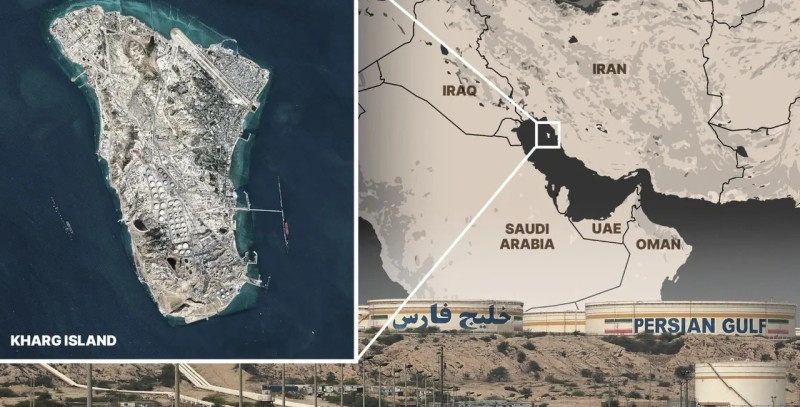
THE United States military has targeted installations on Kharg Island, Iran’s principal oil export hub, President Donald Trump announced on Friday, signalling readiness to strike oil infrastructure if Tehran continues attacks that have disrupted most shipping through the Strait of Hormuz.
Kharg Island, located 16 miles (26 km) off Iran’s coast and approximately 300 miles (483 km) northwest of the strait, handles around 90 per cent of Iran’s oil exports. In a social media statement, Trump said the U.S. military “totally obliterated every MILITARY target” on the island while leaving the oil infrastructure untouched.
“However, should Iran, or anyone else, do anything to interfere with the Free and Safe Passage of Ships through the Strait of Hormuz, I will immediately reconsider this decision,” Reuters cited Trump writing, issuing a stark warning that could further unsettle already volatile global energy markets.
The president added that Iran lacks the capability to defend against U.S. military action. “Iran’s Military, and all others involved with this Terrorist Regime, would be wise to lay down their arms, and save what’s left of their country, which isn’t much!” he said.
Global oil prices have reacted sharply to the uncertainty created by Trump’s shifting statements on the likely duration of the conflict. While the president previously suggested the war might last only weeks, he declined on Friday to publicly estimate an end date, telling reporters, “I can’t tell you that. I mean, I have my own idea, but what good does it do? It’ll be as long as it’s necessary.”
Despite regional turmoil, Iran has continued exporting crude oil from Kharg Island while other Gulf producers have paused shipments due to fears of Iranian attacks.
Satellite imagery reviewed by TankerTrackers.com showed multiple very large crude carriers loading at the island on Wednesday. Between 28 February and the following Wednesday, Iran reportedly exported between 1.1 million and 1.5 million barrels per day.
Market analysts are closely monitoring the island’s network of pipelines, terminals, and storage tanks, as even minor disruptions could further tighten global supply.
Bob McNally, president of Rapidan Energy Group, said Trump’s remarks would “focus the market’s mind on pathways that this energy disruption, already history’s largest, could expand and last longer.”
Some industry observers expressed scepticism about the U.S. claim that the oil facilities remained intact.
Josh Young, chief investment officer at Bison Interests, remarked, “Bombing Kharg Island but not the oil infrastructure is like going to McDonald’s and getting a hamburger with no meat. What’s the point?”
Iran’s new Supreme Leader, Mojtaba Khamenei, in his first public statement on Thursday, vowed to keep the Strait of Hormuz closed and urged neighbouring states to remove U.S. military bases from their territories or risk attacks.
Trump indicated that the U.S. Navy will “soon” begin escorting tankers through the strait, while European powers, including France, have been consulting with European, Asian, and Gulf states on plans to protect shipping lanes.
The crisis has already affected global energy markets. Rising gasoline and diesel prices prompted the United States to issue a 30-day waiver for countries to purchase sanctioned Russian oil and petroleum products, a move welcomed by Moscow but criticised by Kyiv and its allies.
Ukrainian President Volodymyr Zelenskiy warned it could provide Russia with $10 billion and “certainly does not help peace.”
The conflict has now extended across the Middle East, with nearly two weeks of fighting leaving 2,000 dead, primarily in Iran, but also in Lebanon and other Gulf countries.
Several million people have been displaced, while Israeli airstrikes on Beirut’s suburbs have overwhelmed local authorities. Leaflets dropped over Gaza warned of potential devastation as Israel deployed more troops against Iran-backed Hezbollah.
U.S. forces have also suffered casualties, with all six crew members of a refuelling aircraft killed in western Iraq. Iran has launched additional missile and drone attacks on Israel, and Iranian drones have been reported over Kuwait, Iraq, the United Arab Emirates, Bahrain, and Oman.
The Israeli military has conducted strikes on over 200 targets in western and central Iran, including missile launchers, air-defence systems, and weapons production facilities.
The United States is sending additional forces to the region, including the USS Tripoli with its Marine expeditionary unit and 2,500 Marines, accompanied by extra naval personnel, to bolster operations amid escalating hostilities. - March 14, 2026










