


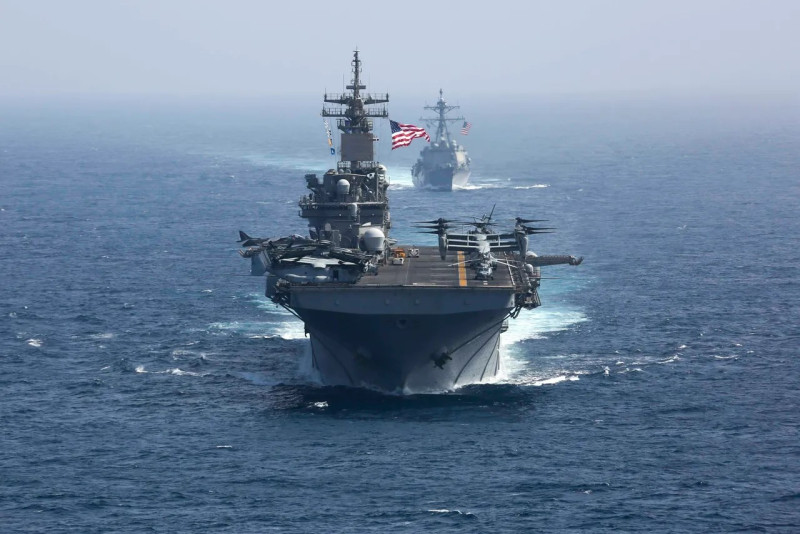
THE United States is deploying thousands of additional Marines to the Middle East as conflict with Iran intensifies, raising fears of a broader war and severe disruption to global energy supplies.
Officials said around 2,500 Marines, along with the amphibious assault ship USS Boxer and accompanying vessels, are being sent to the տարածաշրջ region, although their precise role has not been disclosed.
Reuters reported on Saturday that the deployment comes as President Donald Trump criticised NATO allies for refusing to commit forces to secure the Strait of Hormuz, a vital oil corridor through which roughly a fifth of global oil and liquefied natural gas supplies pass.
The strait has been largely closed to shipping since the United States and Israel launched military operations against Iran nearly three weeks ago, triggering a sharp escalation in hostilities across the region.
Oil prices have surged by around 50 per cent since the conflict began on February 28, as attacks on refineries and energy infrastructure in Iran and neighbouring Gulf states threaten to destabilise global markets.
In a bid to ease supply pressures, Washington said it would temporarily waive sanctions on Iranian oil, allowing the sale of 140 million barrels stranded at sea.
Despite the military build-up, there has been no decision on deploying ground troops inside Iran.
Potential targets under consideration reportedly include coastal military sites and the Kharg Island oil export hub.
Trump suggested US objectives were close to being achieved, including weakening Iran’s military capabilities and preventing it from developing nuclear weapons, while also indicating operations could be scaled back.
“We have nobody to talk to,” Trump said. “And you know what? We like it that way.”
However, domestic sentiment appears increasingly cautious.
A Reuters/Ipsos poll found nearly two-thirds of Americans believe Trump will order a large-scale ground war, while only 7 per cent support such a move.
European allies including Germany and France have indicated they would only support efforts to secure maritime routes if a ceasefire is reached, underscoring divisions within the Western alliance.
Meanwhile, Israel said it had launched two waves of air strikes on Tehran and central Iran, targeting weapons production facilities and ballistic missile infrastructure, while also intercepting incoming missile attacks that triggered sirens in Tel Aviv and Jerusalem.
Fragments from an Iranian missile landed near the Old City of Jerusalem, a site sacred to multiple faiths, though no casualties were reported.
Iran, for its part, said it had struck targets in Israel and attacked US-linked military assets in the region, while also hitting energy infrastructure, including a refinery in Kuwait.
The conflict has already killed more than 2,000 people, mostly in Iran and Lebanon, and displaced large numbers amid intensifying cross-border strikes involving Iran-backed Hezbollah.
As the war deepens, uncertainty has also surrounded Iran’s leadership. Mojtaba Khamenei issued a defiant message marking Eid al-Fitr and Nowruz, praising national unity and resistance.
His absence from public view since the killing of his father and predecessor Ali Khamenei in the early days of the conflict has fuelled speculation about internal stability.
“We have dealt a disorienting blow to the enemy,” Mojtaba Khamenei said.
The war has also begun to weigh on domestic politics in the United States, with rising fuel costs threatening economic stability ahead of upcoming elections.
Benchmark Brent crude hovered near US$110 a barrel after sharp gains, as disruptions amounting to roughly 12 million barrels per day — about 12 per cent of global demand — strain supply chains.
With key military facilities hit and exports curtailed, analysts warn the effects could reverberate for months or even years, amplifying the risk of a broader global economic shock. - March 21, 2026










