


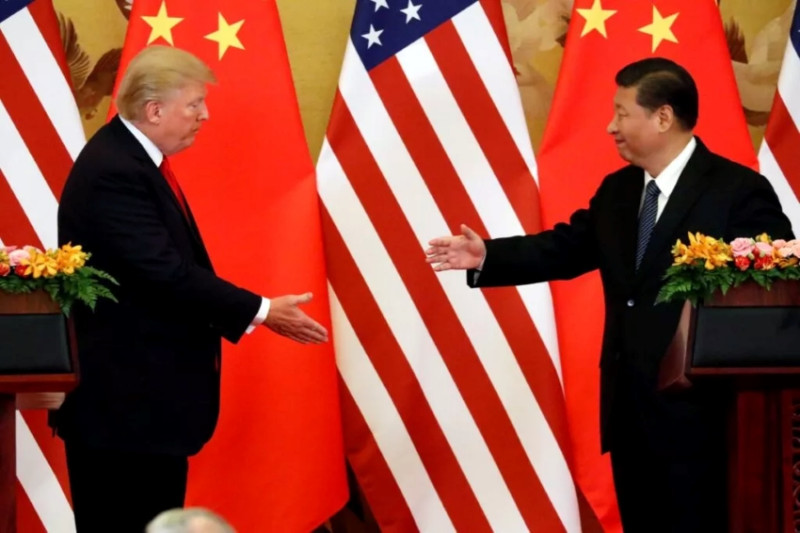
U.S. President Donald Trump is expected to travel to China in May for talks with China’s Premier Xi Jinping, marking his first visit to the country in eight years and a pivotal moment in efforts to stabilise relations between the world’s two largest economies.
Reuters cited on Monday that the visit follows a turbulent period in which Washington introduced sweeping and, at times, unpredictable global tariffs, reshaping the economic relationship between the two powers.
What began as a cycle of retaliatory duties has since evolved into a more complex phase of managed tensions, punctuated by multiple rounds of negotiations, high-level calls and a leaders’ meeting last year.
Developments this year have underscored both confrontation and cautious engagement.
In March, the United States launched new Section 301 investigations into alleged unfair Chinese trade practices, prompting reciprocal probes from Beijing.
Preparations for a summit were already in motion, though the visit was postponed to mid-May as the Iran war continued to influence geopolitical priorities.
The same month, senior officials including U.S. Treasury Secretary Scott Bessent and Trade Representative Jamieson Greer met Chinese Vice Premier He Lifeng and chief negotiator Li Chenggang in Paris for a sixth round of talks described by both sides as "constructive."
In February, the U.S. Supreme Court rejected Trump’s global tariff regime, though the president signalled his intention to continue deploying tariffs as a policy tool.
Earlier, in January, China reported a record trade surplus for 2025, buoyed in part by a strategic pivot towards Southeast Asia, Africa and Latin America as exports to the United States declined.
The broader trajectory of 2025 reflects a pattern of escalation followed by temporary de-escalation.
In October, China expanded export controls on rare earth elements and tightened scrutiny on semiconductor usage, asserting its dominance in critical minerals.
Washington responded with additional tariffs, including duties reaching 100% on certain imports, alongside export controls targeting key software.
Both countries also imposed measures affecting each other’s shipping sectors.
A subsequent meeting between Trump and Xi in Busan, South Korea, resulted in a renewed trade truce, with Washington agreeing to scale back some tariffs while Beijing committed to curbing illicit fentanyl flows, resuming U.S. soybean imports and pausing restrictions on rare earth exports.
Earlier in September, both sides held discussions over the future of TikTok and explored broader trade issues spanning chemicals and aviation components.
Between June and August, signs of stabilisation emerged as China began granting export licences for rare earth magnets and the United States permitted limited exports of advanced artificial intelligence chips, including those from Nvidia.
Trump also pressed China to significantly increase purchases of American soybeans, while an existing tariff truce was extended by 90 days.
Initial efforts to ease tensions began in May with talks in Geneva, where both countries agreed to a 90-day pause that reduced elevated tariffs.
However, the agreement quickly came under strain, with Trump accusing China of breaching commitments to roll back tariffs and ease mineral export curbs, while Beijing criticised Washington for imposing what it called "discriminatory restrictive" measures.
The current diplomatic push, culminating in the anticipated May summit, reflects a fragile balancing act as both sides seek to manage deep economic rivalry without triggering further disruption to global trade. - April 6, 2026










