


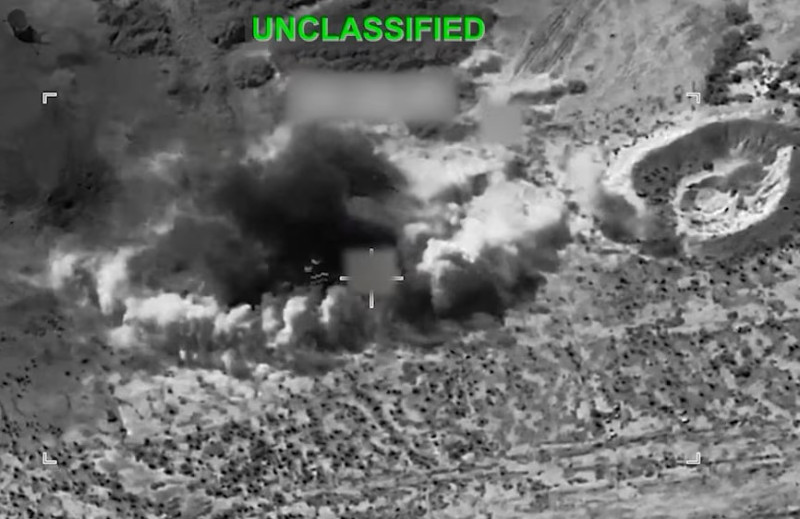
THE United States intensified its military campaign against Iran on Wednesday, launching fresh strikes on coastal defence systems and missile facilities while enforcing a renewed naval blockade, prompting Tehran to warn that the conflict had become an "existential war" with America and raising fears of further disruption to global energy supplies.
The latest escalation follows the collapse of a fragile ceasefire and comes days after Iran announced the closure of the Strait of Hormuz, a vital shipping route that previously carried around one-fifth of the world's oil and gas exports.
Reuters reported on Thursday that military operations in and around the strategic waterway have significantly disrupted maritime traffic, pushing Brent crude to a one-month high of US$84.95 a barrel.
The US Central Command (CENTCOM) said its forces carried out two waves of strikes targeting Iranian coastal defence systems, cruise missile storage facilities and launch sites on Greater Tunb Island, describing the operation as part of efforts to safeguard freedom of navigation through the Strait of Hormuz.
"The strikes are targeting Iranian military capabilities used to threaten vessels freely transiting through the Strait of Hormuz, an international waterway vital to global commerce. The U.S. military is holding Iran accountable at the Commander in Chief's direction," CENTCOM said in a statement on X.
Three US officials told Reuters the operation was also intended to degrade Iranian military capabilities that could threaten future maritime operations if Washington sought to reopen the waterway.
The US military also said it disabled an unladen oil tanker attempting to sail towards Iran's Kharg Island after the vessel ignored repeated warnings. According to the military, Hellfire missiles were fired into the ship's smokestack, while two other vessels were redirected under the renewed naval blockade.
Iranian media reported explosions at multiple locations, including Ahvaz, Bandar Abbas, Konarak, Sirik and Qeshm, although no casualties were immediately reported.
However, state broadcaster IRIB said one US strike landed near a hospital in Ahvaz that houses a paediatric cancer centre, forcing a temporary evacuation as families moved children to safety outside the facility.
Following the first wave of attacks, Iranian negotiator Mohammad Baqer Qalibaf declared that Tehran remained committed to maintaining what he described as "Iranian arrangements" governing the Strait of Hormuz.
"We are in an essential and existential war with America," Qalibaf said.
The Islamic Revolutionary Guard Corps (IRGC) later claimed responsibility for attacks on US military targets across the region, including installations in Bahrain, Kuwait and Jordan.
Kuwait said its armed forces intercepted four missiles and 21 drones launched from Iran, adding that no injuries or damage had been reported.
"The enemy should not assume it can sustain the current course of the conflict and turn it into a war of attrition," IRGC spokesman Hossein Mohebbi said.
"Iran's operations are currently focused on destroying US offensive military infrastructure in the region. The next phase will begin afterward."
The conflict has claimed thousands of lives and displaced millions of people, particularly in Iran and Lebanon, where fighting between Israel and the Iran-backed Hezbollah movement has resumed.
Iran's Tasnim news agency, citing a Health Ministry official, reported that US strikes this month alone have killed 35 people.
US President Donald Trump maintained that Washington was gaining the upper hand while simultaneously suggesting Tehran was seeking negotiations.
"We'll have Iran defeated soon. They'll be defeated very soon," Trump said during the Pennsylvania Defense and Innovation Summit.
"They don't like what we're doing, and they do want to settle. We'll find out whether or not we settle with them, or we just finish it off," he added.
Trump also disclosed that Iran had released an American citizen who had been detained in 2024 under the previous US administration, describing the move as a positive gesture.
"The United States of America appreciates this gesture of Goodwill by Iran," Trump wrote on Truth Social.
Despite the intensifying military confrontation, Iranian officials reiterated that the Strait of Hormuz would only be reopened if Washington complied with the 14-point memorandum of understanding signed by both countries in June and recognised what Tehran described as Iranian regulations governing maritime traffic through the strategic waterway. - July 16, 2026










