


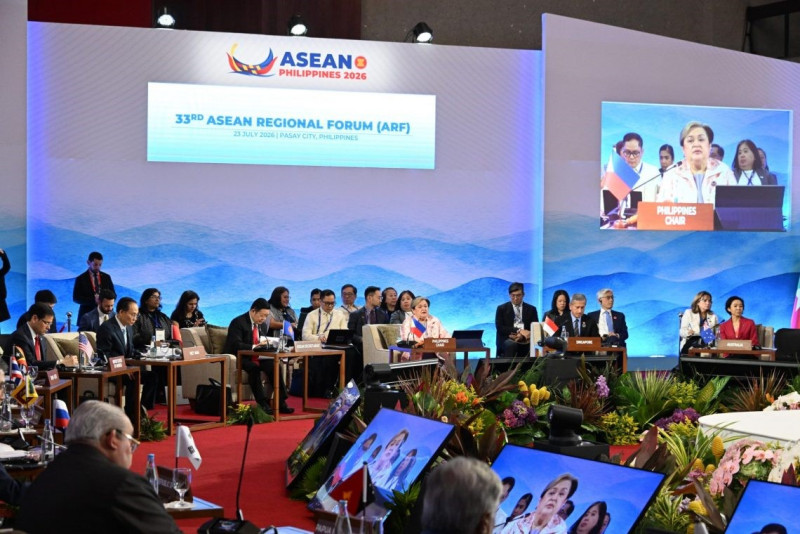
FOREIGN ministers and senior diplomats from Asia, Europe and North America gathered in Manila on Thursday for the ASEAN Regional Forum (ARF), with escalating conflict in the Middle East, global energy security and regional maritime disputes dominating the security-focused agenda.
The meeting brought together senior representatives from the United States, Russia, China, Australia, Britain, the European Union, India, Japan and ASEAN member states at a time of mounting geopolitical instability.
Opening the forum, Philippine Foreign Secretary Maria Theresa Lazaro, whose country currently chairs ASEAN, warned that the region faced an increasingly uncertain global environment requiring greater international cooperation.
"We convene against the backdrop of profound geopolitical and geoeconomic uncertainty," Reuters quoted her saying.
"These issues transcend borders and underscore the reality that no nation can address today's complex security environment alone."
The conflict involving Iran and the continued blockade of the Strait of Hormuz featured prominently in discussions, reflecting growing concern among ASEAN economies, which remain heavily dependent on energy imports from the Middle East.
The disruption has heightened fears over global oil supply constraints, rising energy prices and renewed inflationary pressures across Asia.
The United States has continued military operations against Iran, while Iran-aligned Houthi forces claimed attacks on two Saudi oil tankers, adding to concerns over shipping disruptions in both the Strait of Hormuz and the Red Sea—two of the world's most strategically important maritime trade routes.
China's Vice Foreign Minister Hua Chunying told a separate meeting involving ASEAN, China, Japan and South Korea that the world had entered a "new period of turbulence and transformation", stressing the urgent need to preserve peace and regional stability.
US Secretary of State Marco Rubio reiterated that Washington preferred a diplomatic solution to the Middle East crisis, although he said progress remained elusive.
On the sidelines of the forum, Rubio met Russian Foreign Minister Sergei Lavrov for nearly an hour to discuss the war in Ukraine and broader US-Russia relations.
Russia's Foreign Ministry said Lavrov reaffirmed Moscow's willingness to pursue a political and diplomatic settlement of the conflict and remained committed to proposals advanced by both countries' leaders.
The US State Department said the meeting covered bilateral relations and "the need to end the Russia-Ukraine war."
Beyond the Middle East, tensions in the South China Sea remained another major focus of regional discussions following fresh confrontations between Chinese and Philippine vessels.
China's coast guard accused the Philippines of carrying out another "provocative" intrusion near the disputed Scarborough Shoal on Thursday, saying it had taken measures to block the vessel.
The Philippine Coast Guard, however, said one of its government fisheries vessels undertaking what it described as a humanitarian mission was targeted with water cannon by Chinese vessels.
The latest confrontation followed an earlier incident on Monday near another disputed reef within the Philippines' exclusive economic zone, prompting both countries to summon each other's ambassadors.
Beijing continues to claim sovereignty over most of the South China Sea, overlapping the exclusive economic zones of Brunei, Indonesia, Malaysia, the Philippines and Vietnam, despite a 2016 international arbitral ruling that rejected the legal basis for many of China's maritime claims.
Chinese Foreign Minister Wang Yi did not attend Thursday's forum, having travelled to Kyrgyzstan for another regional meeting.
However, during earlier meetings with ASEAN counterparts, Wang described the South China Sea as "our common home" and urged regional countries to resist "the incitement of foreign forces" and avoid actions that could inflame tensions.
Meanwhile, China began two days of live-fire military exercises in parts of the Taiwan Strait on Thursday, a day after Wang met Rubio in Manila for talks covering a range of bilateral issues, including Taiwan.
The exercises follow large-scale military drills conducted by Beijing around Taiwan late last year, underscoring continuing strategic tensions across the Indo-Pacific. - July 23, 2026










