


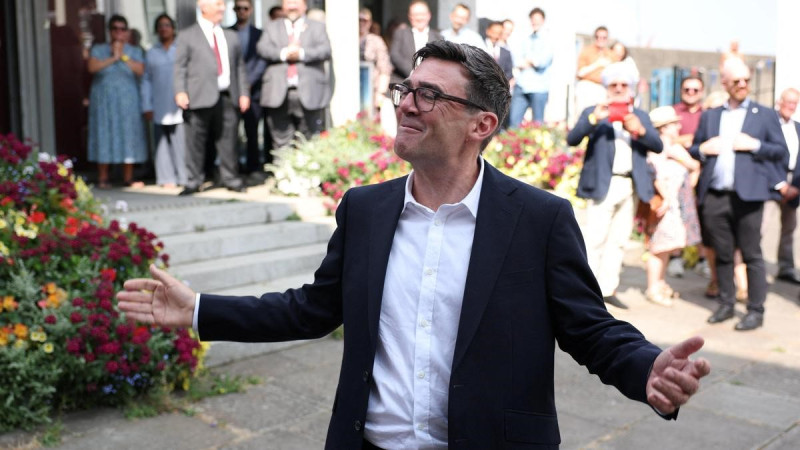
BRITISH Prime Minister Andy Burnham has used his opening week in office to signal a decisive shift in priorities and governing style, seeking to draw a clear distinction from predecessor Sir Keir Starmer through a stronger emphasis on tackling the cost-of-living crisis and decentralising power across England.
The former Greater Manchester mayor has positioned household affordability at the centre of his administration, announcing a series of early measures designed to provide immediate relief for families and businesses grappling with persistent economic pressures.
AFP reported on Sunday that among the initiatives unveiled were the abolition of a tax on household electricity bills, a planned cap on most bus fares across England and a 20 per cent reduction in business rates for pubs, clubs and live music venues.
The announcements represent a markedly different opening to Burnham's premiership compared with Starmer's first months in office, when Labour faced political backlash after reducing winter fuel payments for millions of pensioners before eventually reversing the policy.
Although Burnham has insisted the measures are funded through a reprioritisation of government spending rather than additional borrowing, economists and political observers are watching closely to see whether his administration maintains the fiscal discipline that characterised the previous government.
His domestic agenda could also come under pressure from external events, with rising global energy prices linked to the conflict involving the United States and Iran threatening to complicate efforts to reduce household costs.
A DIFFERENT STYLE OF LEADERSHIP
Burnham has also moved swiftly to reshape Labour's public image by adopting a more informal and optimistic leadership style.
His first address outside Downing Street was delivered without notes or the traditional lectern, reflecting the accessible approach that became synonymous with his tenure as Mayor of Greater Manchester.
While he has adopted the conventional attire expected of a prime minister, Burnham has continued engaging the public through casual, selfie-style videos on social media, reinforcing his reputation as a more approachable political figure.
In his inaugural speech, he pledged to "bring back hope", contrasting with Starmer's frequent emphasis on the difficult choices facing Britain after more than a decade of Conservative rule.
Political analysts said the upbeat messaging is intended to reassure voters that government can deliver tangible improvements despite ongoing economic challenges.
Power Beyond Westminster
One of Burnham's most symbolic early decisions was the launch of a new "No. 10 North" office in Manchester, where he intends to work at least one day each week.
He described the office as the "nerve centre for a rewired Britain", underlining his commitment to strengthening devolution and shifting decision-making closer to communities outside London.
The move reflects Burnham's long-standing advocacy for greater regional autonomy and is expected to form a central pillar of his government's domestic reform agenda.
Political Tests Ahead
Despite an energetic start, Burnham faces significant political and economic challenges.
His Cabinet reshuffle, which saw several ministers associated with Starmer replaced by allies, has fuelled criticism that his pledge to unite Labour sits uneasily with the scale of changes made to the ministerial team.
Burnham has defended the appointments, arguing that a new administration requires ministers who share its priorities and vision.
He is also likely to face continued scrutiny over his mandate after becoming prime minister through Labour's parliamentary majority rather than a fresh general election.
Reform UK leader Nigel Farage has repeatedly called on Burnham to seek a new electoral mandate, although the next scheduled general election is not due until 2029.
Political observers said those demands could intensify if Burnham departs significantly from Labour's 2024 election manifesto or if Britain's economic outlook deteriorates.
While Burnham has made an assertive start, analysts said the longer-term success of his premiership will depend on whether early political momentum can be translated into lasting improvements in living standards, economic growth and regional prosperity. - July 26, 2026










