


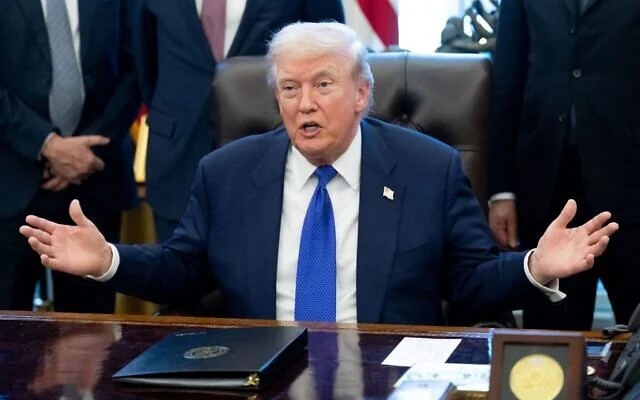
US President Donald Trump has announced that the United States and Israel will hold off on launching new strikes against Iran, but only if a deal to end the five-month conflict can be reached quickly.
The announcement came after growing fears that the war could escalate once again, following Trump’s warning that the United States was prepared to launch further attacks, including possible strikes against Iran’s energy infrastructure.
Trump said Washington remained “locked and loaded and ready to go against the Islamic Republic of Iran”, but claimed Tehran and other Middle Eastern nations had appealed to him to delay further military action.
“Based on this request, I have agreed, for the future benefit of the world and, likewise, the survival of a successful and prosperous Iran, to cancel the attack, subject to being able to rapidly make a deal,” AFP cited Trump saying in a post on his Truth Social platform.
The US President said any agreement would require “the immediate, complete and total opening of the Hormuz Strait and an end to Iran’s nuclear threat”.
“The country of Israel joins me in this commitment. Get to work, everybody, and get it DONE.”
The conflict began on Feb 28 when the United States and Israel launched strikes on Tehran, triggering months of retaliatory attacks and a prolonged confrontation with no clear end in sight.
A previous ceasefire arrangement involving similar conditions, including the reopening of the Strait of Hormuz, collapsed after Iran tightened control over the strategic waterway and fighting resumed in recent weeks.
The renewed clashes have pushed global oil prices higher after they had eased during the initial ceasefire period.
The latest developments also come just three months before the US midterm elections, which could pose a political challenge for Trump’s Republican Party.
Trump’s decision to suspend possible strikes followed warnings from US allies in the Gulf, with reports saying Saudi Arabia’s Crown Prince Mohammed bin Salman urged the president to avoid further escalation.
According to Axios, citing unnamed US officials, the Saudi Crown Prince called Trump on Aug 1 to express concerns over the planned attacks and urged him to “de-escalate and refrain from launching the strikes”.
The White House did not immediately respond to requests for comment regarding the report.
The United States and Iran resumed exchanges of fire in July after a brief lull, although no strikes were reported overnight from July 31 to Aug 1.
US Secretary of State Marco Rubio said earlier that Washington had significantly weakened Iran’s military capabilities and that Tehran appeared increasingly willing to negotiate on nuclear issues and access through the Strait of Hormuz.
“We wiped out” much of Iran’s defences, Rubio told Fox News, adding that Tehran was “now willing and, in some cases, seems eager to do a deal on denuclearisation, to do a deal on the straits”.
However, he cautioned that Iran “could still do damage”.
Tensions remained high after a drone struck a US-owned gas vessel at an Egyptian port on July 29, causing a fire, while an “unknown projectile” hit a tanker off the coast of Oman on Aug 1, according to a British maritime agency.
Iran has maintained effective control over navigation through the Strait of Hormuz since the outbreak of the war, requiring vessels to seek permission and pay transit fees before passing through the vital shipping route.
Maritime trade tracking firm Kpler said traffic through the strait had dropped “sharply” by July 31, raising concerns over global energy supplies.
Meanwhile, Iran-backed Houthi rebels in Yemen denied on Aug 1 that they were attempting to impose charges on ships travelling through the Bab el-Mandeb Strait, another key maritime passage linking the Red Sea to the Indian Ocean and the Mediterranean through the Suez Canal.
The unfolding crisis continues to place pressure on international efforts to prevent a broader regional war while safeguarding one of the world’s most important energy corridors. - August 2, 2026










