


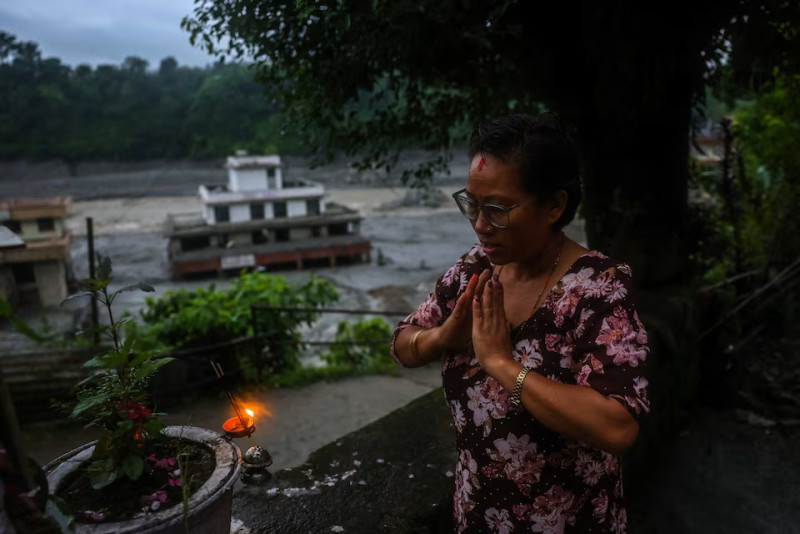
NEPAL has suspended search and rescue operations because of worsening weather and is seeking specialised foreign technical assistance as authorities race to respond to the devastation caused by a glacier-triggered flood along the border with Tibet.
The Himalayan nation of about 30 million people is also expected to need between US$4 billion and US$5 billion to rebuild infrastructure destroyed by Wednesday’s catastrophic flood, Finance Minister Swarnim Wagle told Reuters.
Reuters reported on Saturday that at least 626 people have died in Nepal and another seven in China’s Tibet after a massive torrent of rock, ice, mud and debris, triggered by a glacier collapse, swept through mountain river systems, destroying buildings, bridges and power stations.
Nearly 3,000 people remain missing — about 2,426 in Nepal and at least 558 in Tibet’s Gyirong County — including at least 540 foreign nationals, many of them Hindu pilgrims from India.
Nepal’s authorities said the immediate priority was not general search and rescue assistance but specialised technical support for particularly difficult operations.
“Search and rescue operations have been temporarily halted because it is raining and the weather is foggy,” Narendra Pariyar, the top bureaucrat for badly hit Rasuwa district, told Reuters.
The focus is now on arranging land transport to move rescued pilgrims to Kathmandu, he said.
Nepal Foreign Minister Shisir Khanal said the country needed international assistance in areas where it lacked the necessary expertise and technical capabilities.
“We have already made requests for such specialised services and technical assistance in areas where we don't have enough expertise and technical know-how,” he told Reuters late on Friday.
The requested assistance includes rescuing people trapped inside tunnels, reopening transport and communications routes where bridges have been destroyed, identifying bodies, conducting DNA testing and providing facilities to preserve bodies for longer periods.
Authorities are also continuing to monitor two upstream lakes near the disaster zone after one lake formed across the Nepal-China border and began overflowing into Nepal’s Lhende Khola and Trishuli rivers.
The lake prompted authorities to briefly suspend rescue operations on Friday, while officials warned that the risk of further flooding would remain until both lakes had fully drained.
China’s state-run Xinhua news agency reported that one of the lakes was shrinking, although a Chinese government geohazards expert warned that it could remain unstable. More than 100 other glacial lakes in the wider area could also pose a threat, the expert said.
India has already provided assistance, sending three flights carrying about 60 tonnes of relief supplies, including blankets, medicines, food and water-purification tablets.
New Delhi also plans to send a tunnel-rescue team and a medical team, while offering its disaster response force, prefabricated bridges and technical personnel to help restore connectivity.
Beijing has called for emergency aid to the affected areas of Nepal and international cooperation in rescue efforts, although it has not provided details of what assistance it will send to Nepal.
Wagle said Nepal’s initial reconstruction estimate was between US$4 billion and US$5 billion, although the figure could change as authorities assess the full scale of the destruction.
“This is just an estimate. Loss and damage is being assessed,” he said.
On the Chinese side, rescuers have been searching for more than 500 people still missing after the disaster.
Rescue teams on Friday reached the worst-hit Gyirong border crossing complex after navigating mountains and valleys and using ropes to cross forests and cliffs where roads had been destroyed.
Surveillance camera footage from the crossing showed torrents of water and debris engulfing buildings as people fled when the flood struck. - August 29, 2026










