


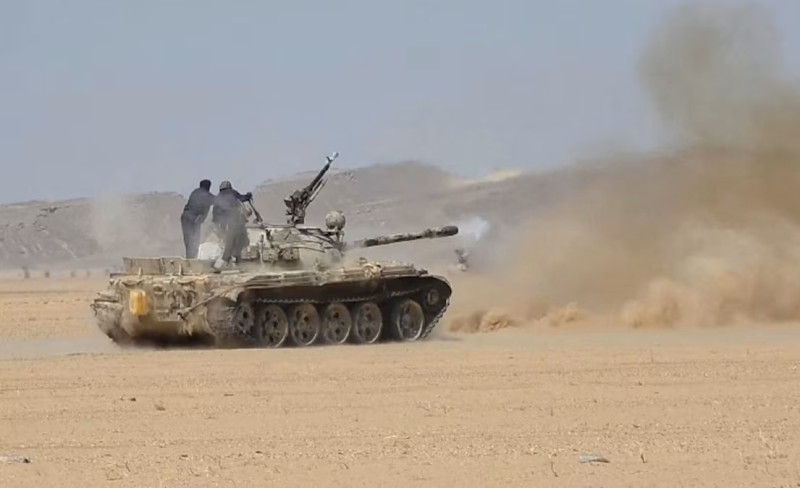
IRAN-aligned Houthis seized Yemen’s port city of Mocha on Thursday and advanced along the Red Sea coast towards strategic islands, deepening a regional conflict that threatens one of the world’s most important shipping routes.
Reuters, on Friday, cited Yemeni government military sources saying the Houthi advance had given the group greater leverage over the Bab el-Mandeb Strait, the southern gateway to the Red Sea, with its forces reaching the Hanish Islands.
The development raises the prospect of further disruption to shipping through the waterway, particularly as the Strait of Hormuz remains effectively closed amid the wider US-Iran conflict.
Control of both strategic waterways could severely constrain energy shipments and put further upward pressure on global oil prices.
Brent crude rose as much as 4 per cent on Thursday to above US$105 a barrel, while the average US diesel price surpassed US$6 a gallon for the first time, according to GasBuddy.
Yemeni government, Iranian and regional sources told Reuters that the Houthi advance down the coast this week was carried out with direct guidance from Iran’s Islamic Revolutionary Guard Corps.
Houthi-run humanitarian operations coordination centre said Red Sea navigation remained safe for all shipping companies except Saudi vessels.
Saudi Arabia, the world’s largest oil exporter, has relied more heavily on the Red Sea route since the Iran conflict effectively closed the Strait of Hormuz, through which about a fifth of global oil supplies flowed before the war.
Yemeni government forces and their allies were relocating south along the Red Sea coast towards Dhubab, near the Bab el-Mandeb Strait and opposite Perim Island, military sources said.
Control of Dhubab and Perim Island would be key to establishing control over the strait, they said.
UN Special Envoy for Yemen Hans Grundberg told the UN Security Council that the international community must act to address “a new and more dangerous phase” in Yemen’s war.
The Houthis’ capture of Mocha gave them “a direct presence on the approaches to one of the world’s most vital straits”, raising serious concerns about freedom of navigation, he said.
US representative Jenifer Neidhart de Ortiz accused the Houthis of acting as “agents and tools of Iran”.
“This escalation is unacceptable, and those who enable it bear responsibility for its consequences,” she said.
Iran’s Foreign Ministry said the Yemen conflict could not be resolved through blockade or military action against the Houthis and called for dialogue.
Houthi spokesperson Mohammed Abdulsalam said the group’s operations were defensive and would stop once attacks on Yemen ceased.
The escalation comes after the Houthis joined the war with an attack on Israel in March, declared a naval blockade against Saudi Arabia in July and intensified attacks this month.
Saudi civil defence authorities also issued emergency alerts in Khamis Mushait, in southwestern Saudi Arabia, for the fourth time in 24 hours amid Houthi attacks.
Pakistan has warned Iran to rein in the Houthis to prevent the crisis from escalating, according to Saudi, Pakistani and Iranian sources. A senior Iranian official responded: “Iran does not control the Houthis”.
The fighting comes during the biggest declared wave of US-Iran tit-for-tat attacks on Gulf shipping since the war began in late February.
The US Treasury Department on Thursday announced new sanctions against companies and individuals accused of aiding Hezbollah and other Iranian proxies under its “Operation Economic Outcast” campaign to cut off Tehran’s war funding.
Trump, meanwhile, said he expected the Iran war to end after the US midterm elections in November.
Asked whether he regretted the war because of its potential impact on the elections, Trump said: “I don't believe in the word 'regret.' You can always question yourself a little bit. If I had it do again, I would do exactly as I did.”
He reiterated his view that the war would end immediately after the midterms, which will determine whether Republicans retain control of Congress.
Meanwhile, the Strait of Hormuz remained severely restricted. Only seven vessels transited the waterway on Wednesday, half the 10-day average, according to preliminary ship-tracking data.
Iranian state media reported that the Revolutionary Guards Navy had struck a US unmanned vessel at the entrance to the strait. - September 11, 2026










