


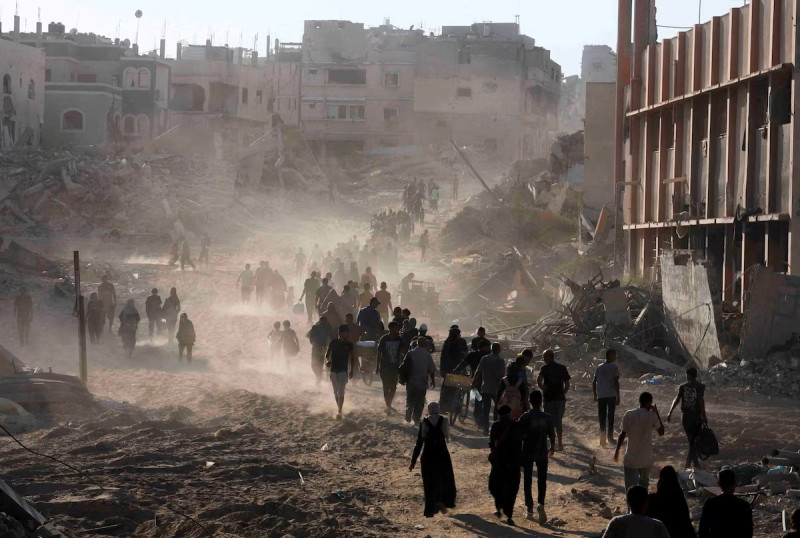
THREE years after Hamas-led militants attacked southern Israel, killing about 1,200 people and abducting 251 others, the trauma of Oct 7 continues to shape Israeli attitudes towards Gaza, with many residents still struggling to see Palestinians there as anything other than a threat.
Along the highway bordering Gaza, memorials, destroyed vehicles and portraits of those killed on Oct 7 remain reminders of the attack, while nearby communities are rebuilding while keeping memories of the bloodshed alive.
At a lookout overlooking the devastated Gaza town of Beit Hanoun, Israelis peer through tourist-style binoculars at buildings reduced to rubble.
For some, the destruction has become a symbol of security restored. An Israeli documentary released this year captured one onlooker describing the devastation as “destroyed beautifully”, while the Associated Press heard similar sentiments at the site.
AP reported on Wednesday that the reaction underscores the depth of the divide three years into a conflict that has devastated Gaza and killed more than 74,000 Palestinians, according to Gaza’s Health Ministry.
For many Israelis, however, the trauma remains intensely personal.
Deganit Bar Hay said she still cannot barbecue because the smell of burnt meat reminds her of the attack and what she described as “the smell of hell”.
“We are post-traumatic, all of us,” said Ziporah Livneh, whose family was largely wiped out in the Holocaust and who came to Israel as a young child.
Livneh said Israelis should continue believing in humanity while responding forcefully to acts of violence, arguing that a society could not be built on revenge but that ignoring evil would also be a form of hypocrisy.
Israeli media have largely remained focused on the victims of Oct 7 and the hostages taken to Gaza, with comparatively little coverage of the lives of Palestinian civilians amid the destruction.
Israel has also continued to restrict journalists' access to Gaza, while few Palestinians are able to leave the territory.
This year marks the first anniversary of the attack since all remaining hostages have been removed from Gaza, either alive or dead.
In the Israeli communities attacked on Oct 7, there are signs of rebuilding alongside efforts to preserve memories of the assault.
Mor Izreal, director of an Oct 7 virtual reality exhibition in the border city of Sderot, said more than 10,000 people, most of them from overseas, had visited since it opened about 18 months ago.
Reactions to the exhibition have ranged from sadness and anger to a sense of connection, she said.
“I know many people around the globe don’t understand us,” Izreal said.
The continuing trauma is unfolding alongside growing international criticism of Israel's conduct of the war and the destruction in Gaza.
An Israeli documentary, “NAZA”, featuring military insiders who describe what they say was systematic killing of Palestinian civilians, has triggered anger among some Israelis, including criticism directed at the filmmakers rather than the government.
Inside Israel, Oct 7 has also become a major political fault line.
The election being held this year is the first since the attack, with Prime Minister Benjamin Netanyahu's government facing intense domestic divisions.
Critics accuse Netanyahu of failing to prevent the attack and of not securing the release of hostages quickly enough. His government has also faced criticism over corruption allegations and disputes involving democratic institutions.
But there has been comparatively little public debate over Israel's treatment of Palestinian civilians in Gaza, where the Israeli military controls more than 60% of the territory and Palestinians have been forced into increasingly confined areas.
In Sderot, Amit Gurfinkel, who spent Oct 7 sheltering with his daughter in nearby Netivot, has called for an official investigation into the security failures surrounding the attack.
He said he spent that day holding a knife and expecting the worst.
Gurfinkel is critical of Netanyahu and concerned about the international consequences of the war, placing him at odds with many residents who continue to support the prime minister and his far-right allies.
At the same time, hostile attitudes towards Palestinians remain visible in public spaces.
Messages including “Death to Arabs” and “Make Gaza Jewish Again” have appeared in areas around Sderot and Jerusalem, while references to Hamas remain common.
Some Israelis argue that Gaza's civilian population cannot be separated from Hamas, while some Palestinians similarly view Israelis through the lens of compulsory military service for most Jewish men and women.
The result is a deepening gulf in perceptions, with little space for discussion of Palestinian civilian suffering.
Adi Marmelstain, visiting a memorial for victims of the Nova music festival massacre, said she believed Palestinians had a right to live but added: “They choose not to.”
Her comments reflected the unresolved trauma and mistrust that continue to shape Israeli society three years after the attack, even as the devastation in Gaza has transformed the conflict into an international political and humanitarian issue. - October 7, 2026










