


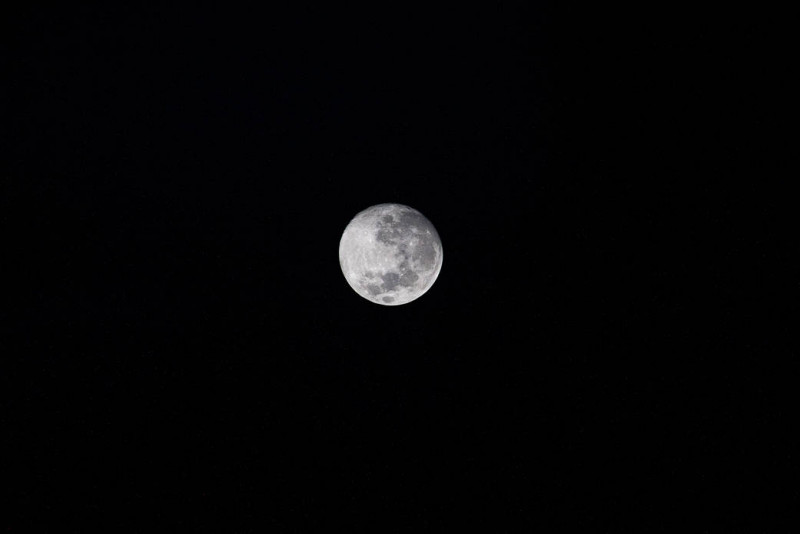
WASHINGTON – As the US prepares to return humans to the Moon this decade, one of the biggest dangers future astronauts will face is space radiation that can cause lasting health effects, from cataracts to cancer and neurodegenerative diseases.
Though the Apollo missions of the 1960s and 1970s proved it was safe for people to spend a few days on the lunar surface, NASA did not take daily radiation measurements that would help scientists quantify just how long crews could stay.
This question was resolved yesterday after a Chinese-German team published in the journal Science Advances the results of an experiment carried out by China's Chang'E 4 lander in 2019.
"The radiation of the Moon is between two and three times higher than what you have on the ISS (International Space Station)," co-author Robert Wimmer-Schweingruber, an astrophysicist at the University of Kiel said.
"So that limits your stay to approximately two months on the surface of the Moon," he added, once the radiation exposure from the roughly week-long journey there, and week back, is taken into account.
There are several sources of radiation exposure: galactic cosmic rays, sporadic solar particle events (for example from solar flares), and neutrons and gamma rays from interactions between space radiation and the lunar soil.
Radiation is measured using the unit sievert, which quantifies the amount absorbed by human tissues.
The team found that the radiation exposure on the Moon is 1,369 microsieverts per day – about 2.6 times higher than the International Space Station crew's daily dose.
The reason for this is that the ISS is still partly shielded by the Earth's protective magnetic bubble, called the magnetosphere, which deflects most radiation from space.
Earth's atmosphere provides additional protection for humans on the surface, but we are more exposed the higher up we go.
"The radiation levels we measured on the Moon are about 200 times higher than on the surface of the Earth and five to 10 times higher than on a flight from New York to Frankfurt," added Wimmer-Schweingruber.
NASA is planning to bring humans to the Moon by 2024 under the Artemis mission and has said it has plans for a long term presence that would include astronauts working and living on the surface.
For Wimmer-Schweingruber there is one work-around if we want humans to spend more than two or three months: build habitats that are shielded from radiation by coating them with 80cm of lunar soil. – AFP, September 26, 2020
















