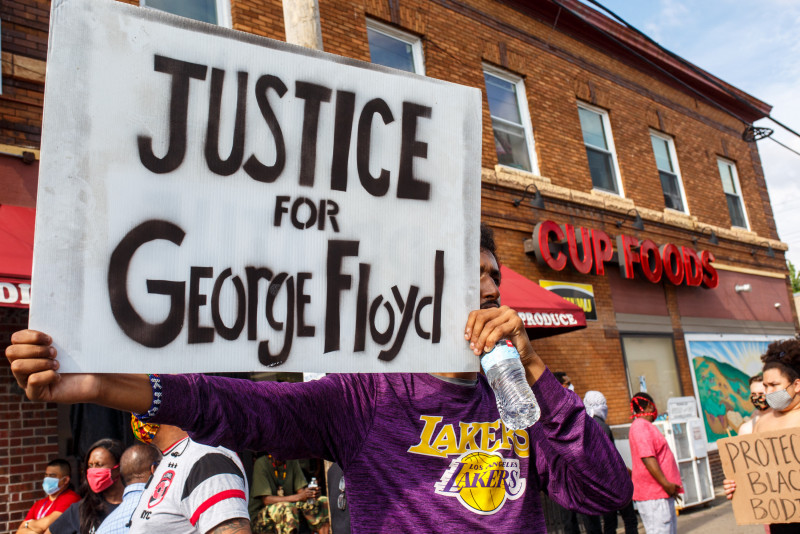
MINNEAPOLIS – A respiratory doctor testified yesterday that George Floyd died from a lack of oxygen and that police officer Derek Chauvin’s knee was on his neck almost all the time he was facedown with his hands cuffed behind his back.
Martin Tobin, a pulmonologist, told the jury at Chauvin’s murder and manslaughter trial that he had watched videos of Floyd’s May 25, 2020 arrest “hundreds of times.”
“Mr. Floyd died from a low level of oxygen,” Tobin told the nine-woman, five-man jury hearing the high-profile case in a heavily guarded Minneapolis courtroom.
“This caused damage to his brain,” he said, and arrhythmia – an irregular heartbeat – which “caused his heart to stop.”
Tobin said Floyd’s breathing weakened because he was “squeezed” face down on the street, handcuffed and with Chauvin and other police officers on his neck and back.
Tobin said that as a doctor in an intensive care unit in a busy Chicago hospital he is “extremely familiar with seeing people die unfortunately.”
He provided commentary as a graphic video of what he said was the moment of Floyd’s death was shown to an attentive jury.
“You can see his eyes, he’s conscious, and then you see that he isn’t,” he said. “One second he’s alive and one second he is no longer.
“That’s the moment the life goes out of his body.”
Drugs, health not a factor
Eric Nelson, Chauvin’s defence attorney, has suggested that Chauvin’s body weight was actually on Floyd’s shoulder or back at times and not on his neck.
Tobin disagreed and said that even after Floyd had stopped breathing, Chauvin continued to pin him down on the street.
“Officer Chauvin’s left knee is virtually on the neck for the vast majority of the time,” he said. “More than 90% of the time in my calculations.”
Tobin noted that at one point in the video Chauvin’s left boot was off the ground meaning that half of the officer’s body weight was on Floyd’s neck.
“The knee remains on the neck for another three minutes and 27 seconds after he takes his last breath,” he said.
“The knee remains on the neck for another two minutes and 44 seconds after the officers have found themselves there’s no pulse.”
The Irish-born Tobin is testifying as an expert witness for the prosecution.
He said he has testified previously at medical malpractice trials but this is his first criminal trial and he is not being paid.
Prosecutors are seeking to prove Floyd’s death was due to asphyxiation, while Chauvin’s defence claims it was due to illegal drugs and underlying health conditions.
Tobin dismissed defence claims that pre-existing medical conditions may have contributed to Floyd's death, along with the impact of the illegal drugs methamphetamine and fentanyl.
“A healthy person subjected to what Mr. Floyd was subjected to would have died,” he said.
As for drugs, Tobin said fentanyl tends to depress breathing but Floyd’s respiratory rate appeared normal before he passed out and died.
‘Begging to breathe’
William Smock, a doctor specializing in forensic medicine, testified that the footage of Floyd’s death showed his voice getting weaker as he ran out of oxygen.
“He’s talking, he’s not snoring,” Smock said. “He is saying ‘please, please get off of me. I want to breathe. I can’t breathe.’ That is not a fentanyl overdose. That is somebody begging to breathe.”
Toxicologist Daniel Isenschmid also told the court that Floyd had relatively low levels of fentanyl in his blood, challenging defence arguments he overdosed.
Several police officers have testified that excessive force was used on Floyd, who was being arrested for allegedly passing a counterfeit US$20 bill in a store.
Police officers are rarely convicted in the United States when charges are brought and a conviction on any of the counts against Chauvin will require the jury to return a unanimous verdict.
Chauvin, who has pleaded not guilty, faces up to 40 years in prison if convicted of the most serious charge – second-degree murder.
A 19-year veteran of the Minneapolis Police Department, Chauvin was fired from the force after Floyd's death.
Three other former police officers involved in the arrest are to be tried separately later this year. – AFP, April 9, 2021