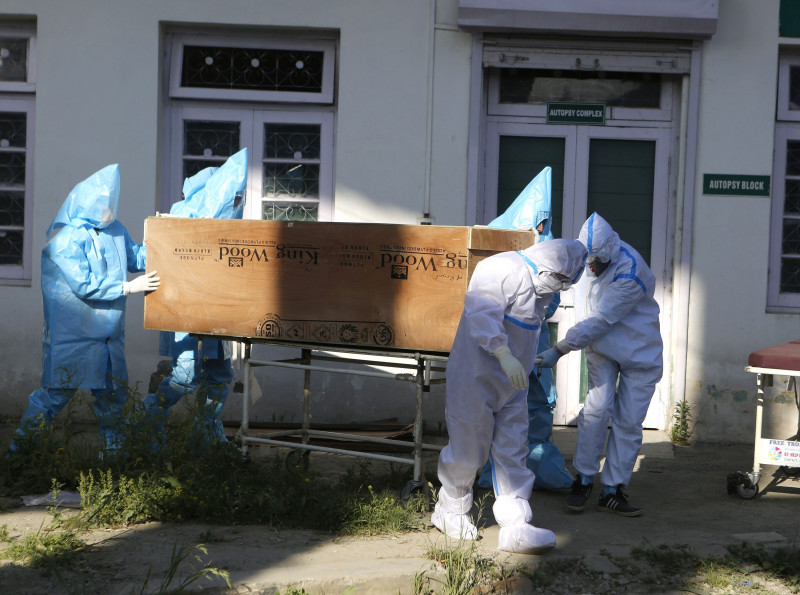
NEW DELHI – India is battling a record-breaking rise in Covid-19 infections that has overwhelmed hospitals and led to severe bed and oxygen shortages.
A key question is whether a new variant with potentially worrying mutations – B.1.617 – is behind what is currently the world’s fastest-growing outbreak, which added more than 300,000 fresh infections yesterday.
The B.1.617 variant has already appeared elsewhere, including in the United States, Australia, Israel and Singapore. Concern about it has led some countries, including the UK, to slap travel restrictions on India.
Here’s what we know.
When did it emerge?
Viruses change all the time and the one that causes Covid-19 has already undergone several thousand mutations – some more concerning than others.
India first reported the B.1.617 genome to the global database (GISAID) in October.
India’s Health Ministry flagged the variant late last month, saying it appeared in 15-20% of samples analysed from the worst-hit state Maharashtra.
More recently, the figure was 60%.
The variant has also been detected in 18 other countries as of this month, according to GISAID.
Should we worry?
B.1.617 has been categorised by the World Health Organisation as a “variant of interest”.
Other variants detected in Brazil, South Africa and the UK have been categorised as “of concern”, because they are more transmissible, virulent or might reduce antibody efficacy.
B.1.617 has several mutations, including two notable ones (E484Q and L452R), leading to it sometimes being called the “double mutant”.
The first notable mutation is similar to another (E484K or sometimes nicknamed “Eek”) observed in the South African, Brazilian, and more recently, the UK variants.
The “Eek” has been dubbed an “escape mutation” as it helps the virus get past the body’s immune system.
The other notable mutation was found by a Californian study to be an efficient spreader.
Scientists say more evidence is needed to determine if these mutations make the B.1.617 variant more dangerous.
Is it behind India’s spike?
Rakesh Mishra, director of the Hyderabad-based Centre for Cellular and Molecular Biology, is one of the scientists currently analysing the B.1.617 variant.
So far, he says it has been “better in terms of spreading compared to other variants”.
“Slowly it will become the more common one and it will replace the other variants,” he told AFP.
It is not yet known, however, if India’s current wave is linked to this variant, or if it is being driven by human behaviour or something else.
Health experts have raised “super spreader” concerns over recent huge religious festivals and political rallies with mostly maskless crowds.
Still, several countries are taking no chances with B.1.617. When it banned travel from India this week, the UK specifically cited fears of the new variant.
The US on Wednesday also advised against travel to India, noting that “even fully vaccinated travellers may be at risk for getting and spreading Covid-19 variants”.
Are vaccines effective against it?
One of the mutations is related to “Eek”, which is suspected of reducing antibody protection from a previous infection or vaccination, said University of Utah evolutionary virology researcher, Stephen Goldstein.
Mishra says scientists were testing vaccine efficacy against the variant.
Even so, experts say vaccines still offer some protection, particularly from severe cases.
What’s next?
Since more variants emerge when there are more infected hosts, Mishra said India needs to get its outbreak under control.
Another variant, the B.1.618, recently raised red flags when it became the third-most detected in India.
Goldstein pointed to the UK’s success at turning around a recent outbreak despite the presence of a more transmissible variant.
“It can be quite onerous, but it can be done,” he told AFP.
“I think the vaccination campaign certainly helped... but it’s the lockdown that enabled them to slow the rise of cases and start to turn the corner.” – AFP, April 23, 2021