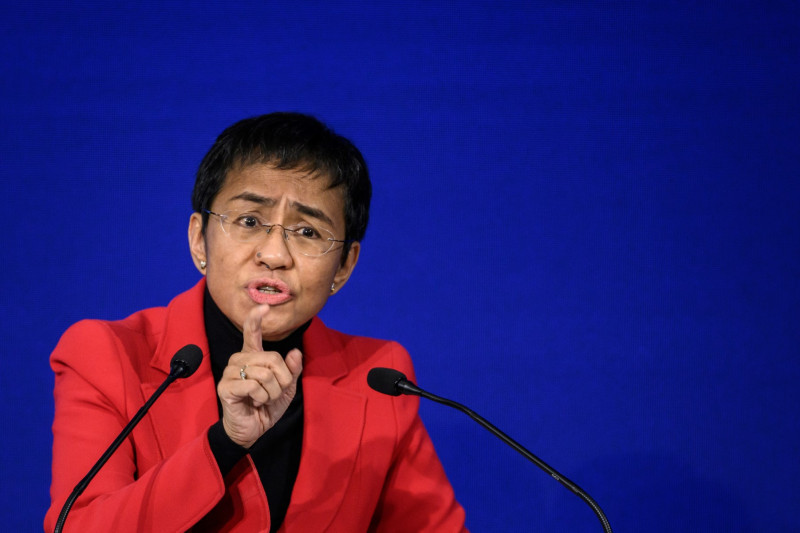
GENEVA – The rise of social media has allowed dangerous propaganda to flourish and left professional journalists facing constant threat of attack, according to Philippine journalist and Nobel Peace Prize laureate, Maria Ressa.
The situation for media workers around the world at the moment is “bleak”, Ressa said in an interview, adding that much of the blame lies with the dramatic shift in the way information is distributed.
Speaking on the sidelines of an event in Geneva on Tuesday to mark World Press Freedom Day, the 58-year-old co-founder of the news website Rappler highlighted how social media had made it far easier to spread propaganda, reject facts and change historical realities.
She pointed to the Philippines, which appears set next week to hand the presidency to Ferdinand Marcos Jr, whose dictator father and namesake presided over massive plunder and human rights abuses in the country.
“He looks set to win, and the only way that is possible is because history shifted in front of our eyes,” Ressa said.
Marcos Jr’s links to his father have made him one of the nation’s most polarising politicians.
But he has benefitted from a deluge of fake and misleading posts on social media platforms targeting a largely young electorate with no memory of the corruption, killings and other abuses committed during the elder Marcos’ 20-year rule.
Separate realities
Ressa pointed at how Marcos Jr has refused to participate in debates and to answer questions from traditional journalists, seeming to follow the playbook of populist politicians like Brazilian President Jair Bolsonaro.
“This is the problem with social media: It has allowed propaganda to flourish and literally has allowed public figures like Marcos, like Bolsonaro to ignore (media) checks and balances...and to create their own realities,” Ressa said.
“That’s not a good thing.”
In the face of such challenges, “the mission of journalism is more important today than ever,” Ressa said.
She says social media first enabled split global narratives around Russia’s annexation of Crimea back in 2014.
That dangerous fragmenting of media narratives has obviously worsened dramatically since Russia’s invasion of Ukraine in February, bringing with it fears of looming nuclear attacks and World War III.
In such an environment, access to reliable facts is vital, Ressa said.
“I think this is one of those moments where everything that (journalists) do will matter, because that’s...how close we are to the edge.”
‘No guard rails’
The dramatic technological shift in the industry has meanwhile left journalists far more vulnerable to attacks and threats.
“There are no guard rails,” Ressa said, pointing to the largely lawless world of social media, often based on algorithms that promote the outrage and hateful debate that drive traffic, and where “troll armies” can easily be unleashed on critics.
“Every time you do a difficult story to try to hold power to account, you have to be ready to get personally attacked.”
Ressa, who shared the 2021 Nobel Peace Prize with Russian journalist Dmitri Muratov, has seen her share of threats, attacks and intimidation.
The vocal critic of Philippines President Rodrigo Duterte and his deadly drug wars faces multiple criminal lawsuits, which she says could see her sent to prison for 100 years.
Ressa sees the Nobel win as “vindication”, voicing “relief” that the Nobel Committee had recognised how difficult journalists’ jobs have become and that “risks have increased.”
The win did not, however, lessen her legal woes, she said, adding that the legal complaints against her and Rappler had in fact “accelerated”.
Ressa said it was unfair that the journalists were being “asked to sacrifice so much”, urging governments and the global community to step up and regulate the technologies that have transformed our information society.
“Guard rails have to be put in place so we can do our jobs.”
Until then, journalists “have no choice” but to continue holding the line as best they can in defence of democracy, Ressa said.
“We’re just putting our finger in the dam and hoping that the rest of society kicks in.” – AFP, May 5, 2022