


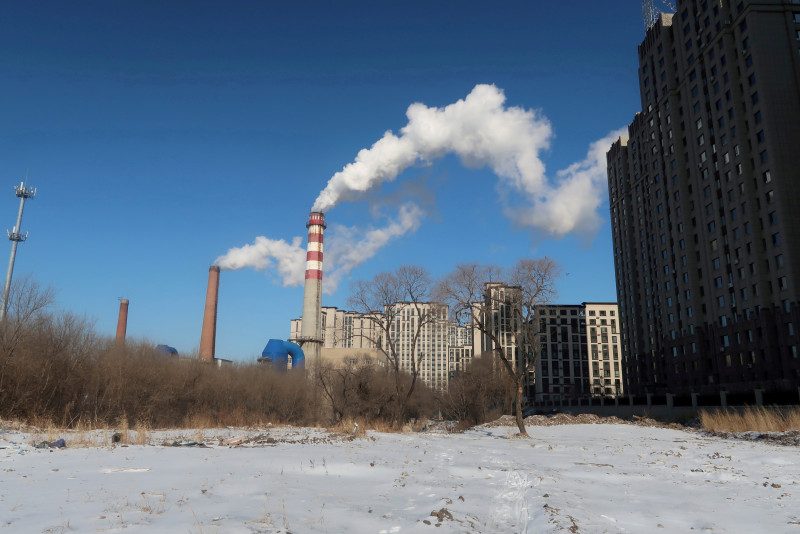
BEIJING – China last year approved the largest expansion of coal-fired power plants since 2015, according to a study published today, despite its vow to begin phasing down use of the fossil fuel in just three years.
The coal power capacity that China began building in 2022 was six times as much as that in the rest of the world combined, the report by the Centre for Research on Energy and Clean Air (CREA) in Finland and the Global Energy Monitor (GEM) added.
“China continues to be the glaring exception to the ongoing global decline in coal plant development,” GEM research analyst Flora Champenois said.
“The speed at which projects progressed through permitting to construction in 2022 was extraordinary.”
China is one of the world’s biggest emitters of the greenhouse gases driving climate change, such as carbon dioxide (CO2).
President Xi Jinping has pledged that China will peak its CO2 emissions between 2026-2030 and reduce them to net zero by 2060, moves seen as essential for keeping global temperature rise well below 2°C.
The report warned that even if Beijing sticks to those commitments, the current coal power expansion will make meeting them “more complicated and costly”.
A total of 106GW of new coal power projects were approved in 2022 – the equivalent of two large coal plants per week – it said.
Plants accounting for around a third of that capacity have already begun construction, with some gaining permits, securing financing, and breaking ground “within a matter of months”.
“This kind of a process leaves little room for... consideration of alternatives,” GEM’s Champenois added.
Vicious cycle
China relies on coal for nearly 60% of its electricity.
Most of the new coal projects have been approved in provinces hit by crippling electricity shortages due to record heatwaves in the last two years.
This creates a vicious cycle with increased greenhouse gas emissions accelerating climate change resulting in more frequent extreme weather events, researchers said.
The rush for approvals started after China’s cabinet in May announced ¥10 billion yuan (RM6.4 billion) of investment in coal power generation.
“This is the same dynamic that we saw during the previous boom in 2015,” said Lauri Myllyvirta, lead analyst at CREA.
“No one knows how long the floodgates will stay open, so local governments try to rush as many projects through as they can.”
Local officials say new coal plants will serve as a backup to ensure stable supplies when renewables fail.
But provinces such as Guangdong, Jiangsu, and Anhui, where the new coal plants are mushrooming, were “laggards” in investing in clean energy to meet demand growth, the study found.
The continued investment in coal “implies insufficient emphasis on overcoming the power system and power market constraints that perpetuate dependence on coal”, it added.
Renewable growth?
China has ramped up its investments in renewable power including solar, wind, hydro, and nuclear plants in recent years.
If that growth continues to accelerate, the report said, and electricity demand stabilises, “the massive additions of new coal-fired capacity don’t necessarily mean that coal use or CO2 emissions from the power sector will increase”, the report said.
However, renewable energy projects in China are struggling to get access to land, while in some areas, the grid cannot absorb all the power generated, the head of the China Photovoltaic Industry Association said this month.
The role of coal in ensuring energy security means developing more renewable power does not necessarily lead to a reduced reliance on the fossil fuel, analysts said.
“The biggest misconception is the idea that an increase in renewables will replace coal,” said Li Shuo, an activist at Greenpeace China.
“That is the case with the rest of the world, but China’s need for energy security has led to growth in wind, solar, and coal all at the same time.” – AFP, February 27, 2023
















