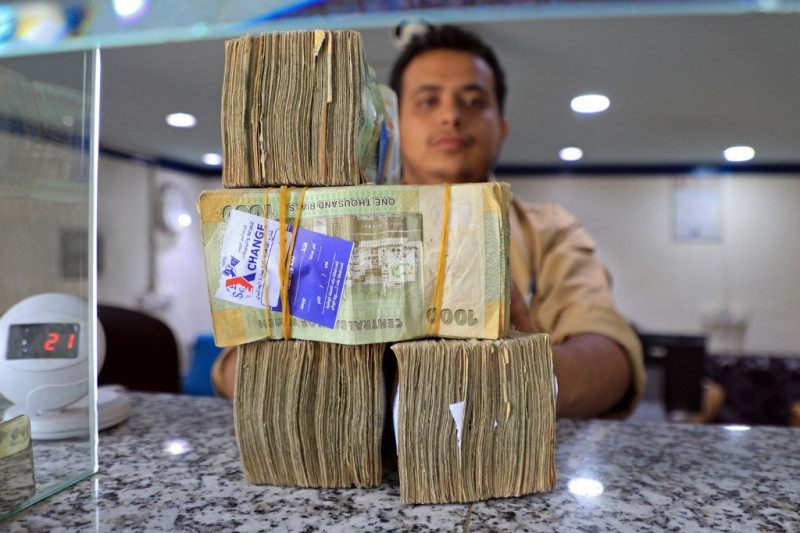
DUBAI – Alongside a grinding seven-year military conflict, Yemen’s government and the Huthi rebels are locked in battle on another front – a currency war that has opened up a gulf in riyal values.
Both the government and the Iran-backed Huthis used the same notes until late 2019, when the rebels banned new banknotes printed in government-run Aden, due to concerns about inflation.
The resulting difference in money supply has since seen the riyal’s value plummet to around 1,000 to the dollar in government areas, while the value in Huthi-controlled zones has held relatively stable at 600.
Citizens and businesses in both government and rebel-controlled zones have been left out of pocket by the divergence, but especially those in the former, given rampant inflation there.
This internal exchange rate has also complicated trade and led to manipulation by profiteers, to the detriment of most in a country on the verge of famine.
“Right now, we have... an exchange rate of the same currency inside the country,” said Amal Nasser, an economist with the Sanaa Centre for Strategic Studies. “This is bizarre from an economic perspective”.
According to Nasser, other experts and ordinary Yemenis, the gap between the two currency values meant higher transfer costs between the two zones.
Inflationary stimulus
Yemen’s conflict has split the country between the mostly Huthi-controlled north, and the south under the internationally recognised government that relocated the central bank to Aden after the insurgents seized Sanaa in 2014.
The war has pushed the nation, long the poorest on the Arabian Peninsula, to the brink of famine and economic collapse, with most schools, factories, hospitals and businesses either destroyed or closed.
As the riyal plummeted to new lows in recent weeks in government areas, the central bank there pledged to withdraw the series of banknotes, which had accumulated in its territory after the Huthi ban in late 2019.
The central bank in Aden was caught out because it had expected the new notes to eventually spread evenly through both zones, but the concentration of supply in the government zone stoked inflation there and spurred the exchange rate divergence.
The government this month introduced a stockpile of what it claims were old bills, drawing the ire of the rebels who accused it of minting new, “counterfeit” money.
Rebel authorities also banned their use and issued civilians with guides to identify the so-called “fakes” – something experts said would be hard for an average citizen to do.
“Obviously, this new injection of money will affect the economy negatively, increase inflation and affect the citizen’s purchasing power,” Alaa al-Haj, an Aden resident, told AFP.
Yemenis were already battling soaring living costs in a country where more than 80% of people are dependent on international aid.
Huthis allege ruse
The Huthis have accused Goznak, a Russian state-owned company, of colluding with the central bank of Aden to print “large amounts of counterfeit currency” this year – “in particular 1,000 riyal notes” to pass new bills off as old.
Wahid al-Fawdai, an adviser to the central bank, said the bills the government recently put into circulation had been in the central bank reserves for several years.
Goznak and the central bank did not comment when contacted by AFP.
Social media and newspapers are rife with stories of profiteers exploiting the unstable economic situation.
Some people have used the rate discrepencies as an opportunity to cash in, including by using the newly issued “old” notes in Aden to buy up those printed after 2017 at a discount of around 20%.
Experts spoken to by AFP believe that the new “old” notes have a strong chance of permeating largely undetected into Huthi areas, since they are hard to distinguish from the earlier old notes.
Ultimately, this should help the central bank in closing the gap in the exchange rate between the two zones, they said. – AFP, August 22, 2021