Business

Slow Covid-19 vaccinations to cost global economy US$2.3 tril: study

Asia-Pacific region will be the worst hit in absolute terms, says Economist Intelligence Unit report

Updated 5 years ago · Published on

Slow Covid-19 vaccinations to cost global economy US$2.3 tril: study
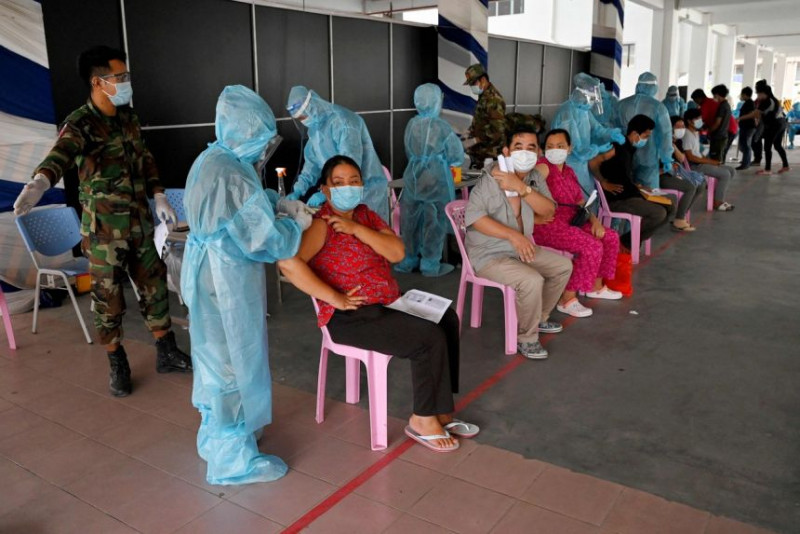
People receiving the Sinovac vaccine in Phnom Penh recently. Around 60% of the population of higher-income countries received at least one dose of the coronavirus vaccine as of late August, compared with just 1% in poorer nations. – AFP pic, August 25, 2021

PARIS – The slow roll-out of coronavirus vaccines will cost the global economy US$2.3 trillion (RM9.6 trillion) in lost output, a report released today found.

The Economist Intelligence Unit’s study found that emerging and developing economies, whose vaccine roll-outs are far behind those of wealthier countries, will bear the brunt of those losses.

The report comes as advanced nations move towards providing booster shots to their populations while the international effort to provide vaccines for poorer nations remains inadequate.

The study calculated that countries, which fail to vaccinate 60% of their populations by mid-2022, will suffer the losses, equivalent to €2 trillion over the 2022-2025 period.

“Emerging countries will shoulder around two-thirds of these losses, further delaying their economic convergence with more developed countries,” the EIU said.

It warned the delayed roll-out of vaccines could fuel resentment, increasing the risk of social unrest in developing economies.

The Asia-Pacific region will be the worst hit in absolute terms, accounting for nearly three-quarters of the losses. 

But as a percentage of GDP, sub-Saharan Africa will suffer the worst losses.

Around 60% of the population of higher-income countries received at least one dose of the coronavirus vaccine as of late August, compared with just 1% in poorer nations, according to the study. Two doses are required to be fully vaccinated for most shots.

“Vaccination campaigns are progressing at a glacial pace in lower-income economies,” it said.

The report’s author, Agathe Demarais, said the international effort to provide coronavirus vaccines to poor nations, Covax, has failed to live up to its even modest expectations.

“There is little chance that the divide over access to vaccines will ever be bridged”, with rich countries providing only a fraction of what is needed, she said in a statement.

“Finally, the focus in developed economies is shifting towards administering booster doses of coronavirus vaccines, which will compound shortages of raw materials and production bottlenecks,” she added.

The EIU said its study was conducted by combining its in-house forecasts for vaccination timelines in around 200 countries with GDP growth forecasts. – AFP, August 25, 2021


Related News

Community / 21h

BOH contributes RM50,000 to Malaysia’s homegrown cancer vaccine research

Business / 1d

Pengerang needs to create wider economic value, not just store more oil, says expert

Business / 2w

Energy disruptions - a timely reminder that energy, economic security are interconnected - Minister

Malaysia / 1mth

Malaysia’s K-shaped economy: Growth without shared prosperity?

Opinion / 1mth

Malaysia’s innovation shortfall stems from a structural phenomenon

World / 1mth

Bangkok floods: The real pain starts when waters recede

Spotlight

Malaysia

Anwar receives special recognition as 10,000 Muslims gather in Putrajaya

Malaysia

Video of elderly man being assaulted goes viral on social media

Malaysia

The wide reach of corruption and organised crime in the country

Malaysia

Malaysia pushes to give smaller economies stronger voice in Asia-Pacific trade – Anwar

Malaysia

No tsunami threat to Malaysia after 5.4-magnitude earthquake hits Banda Sea

Malaysia

Who is calling the shots in Negeri Sembilan as Ismail’s position comes under scrutiny?

Opinion

Ayob Khan: When the uniform comes off, the principles remain

Malaysia

MySiren to send emergency alerts to compatible phones nationwide from Nov 29 test

You may be interested

Business

Govt moves to block seven US-blacklisted entities from accessing local data centres

Business

Pengerang needs to create wider economic value, not just store more oil, says expert

Business

Oil prices holds above US$80 as Hormuz attacks heighten supply concerns

Business

Three Malaysian firms placed on US trade blacklist over advanced technology diversion fears

Business

MAG to add 10 Boeing Dreamliners in long-term fleet expansion drive

Business

Oil retreat offers limited relief as ringgit weakens against firmer US dollar

Business

NexG share surge puts spotlight on RM7.5b takeover proposal as SC examines trading