Food

Christmas grub: Zimbabwean beetle makes a seasonal snack

Despite westernised food tastes in the towns and cities, in the countryside, there remains a tradition of eating insects, mopani worms and white ants

Updated 5 years ago · Published on

Christmas grub: Zimbabwean beetle makes a seasonal snack
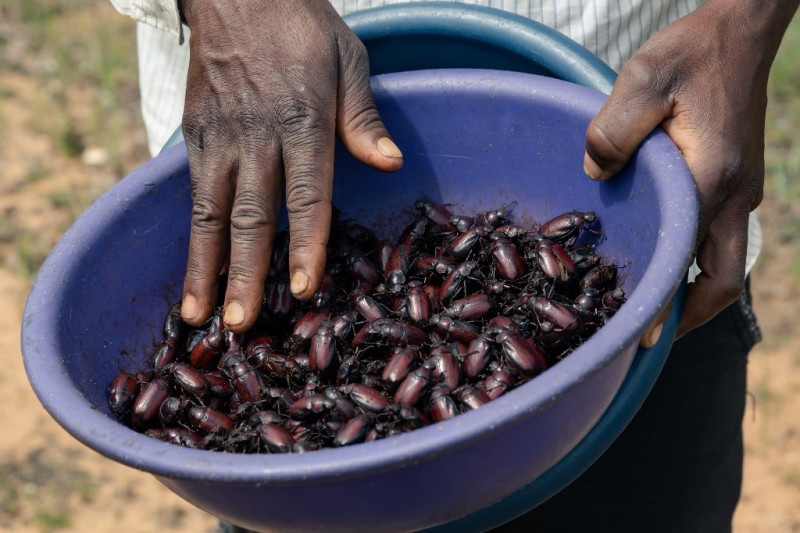
Earnmore Chikavaza, a villager, shows off his bountiful harvest of mandere (chafer beetles, also called Christmas beetles) in a dish after a successful search for the protein-rich edible insects in Mhondoro, Zimbabwe, on December 16. – AFP pic, December 23, 2020

MHONDORO – Earnmore Chikavaza takes a mouthful of fried beetles and munches happily, downing the crunchy snack with a mouthful of water.

He runs out of superlatives to sum up the benefits of a food that is healthy, tasty, organic and – a special advantage in a poor country – absolutely free.

The delicacy is the chafer beetle, also called the Christmas beetle, a dark-red Zimbabwean bug which proliferates in the southern hemisphere country at this time of year.

"You don't spend anything on the beetles. They are free relish," the slender 28-year-old miner told AFP.

"All you have to do is to go out in the bush and shake them off or pluck them from musasa trees and they come in summer when other forms of relish are scarce."

In Zimbabwean towns, food tastes have become westernised, but in the countryside, there remains a time-honoured tradition of eating insects, mopani worms and white ants – the bounty of rich soil and luxuriant vegetation.

Chikavaza lives in Mhondoro, a village about 100 km southwest of the capital Harare.

Three weeks of heavy rain have made it too dangerous to venture into the mining tunnels, so he spends time with a bowl in his hands, shaking beetles out of the trees for food.

Chikavaza takes his harvest to a local lady, Winnie Chikaonda, 72, who helps him cook the insects.

The recipe is simple – the beetles are boiled until soft and then fried until they reach the desired level of crunchiness.

"As children, we used to go out in the bush to harvest them," Chikaonda recalled.

"God created them knowing they were healthy to eat. It’s a pity children from the cities don’t like them. They regard them as creepy creatures that bite." – AFP, December 23, 2020

Related News

Malaysia / 2w

Prepare a 72-hour food supply; avoid panic buying – FOMCA

Malaysia / 3w

Food supplies sufficient; no need for Malaysia to follow 33 other countries - DPM

Opinion / 1mth

Two major issues Malaysia must solve: Food import dependence and population decline

Malaysia / 3mth

Delivery rider’s birthday gesture leaves young boy smiling (video)

Malaysia / 3mth

Malaysia must prepare for the effects of the Gulf War

Events / 4mth

Penang proposes partnership with Medan in the food industry and farming sectors

Spotlight

Malaysia

Anwar receives special recognition as 10,000 Muslims gather in Putrajaya

Malaysia

Video of elderly man being assaulted goes viral on social media

Malaysia

The wide reach of corruption and organised crime in the country

Malaysia

Malaysia pushes to give smaller economies stronger voice in Asia-Pacific trade – Anwar

Malaysia

No tsunami threat to Malaysia after 5.4-magnitude earthquake hits Banda Sea

Malaysia

Who is calling the shots in Negeri Sembilan as Ismail’s position comes under scrutiny?

Opinion

Ayob Khan: When the uniform comes off, the principles remain

Malaysia

MySiren to send emergency alerts to compatible phones nationwide from Nov 29 test

You may be interested

Our Planet

Beaver Supermoon lights up November skies, begins four-month celestial spectacle

Events

Seven companies selected for RM15m corporate innovation programme

By Alfian Z.M. Tahir

Health

Selangor records 18,451 haze-related illnesses, with Petaling clinics hardest hit

Community

BOH contributes RM50,000 to Malaysia’s homegrown cancer vaccine research