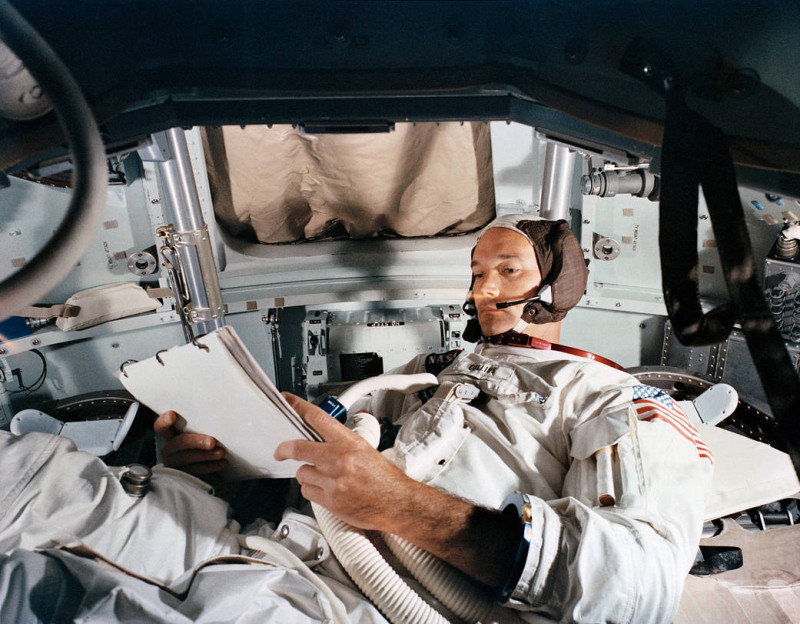
WASHINGTON – American astronaut Michael Collins, who piloted the Apollo 11 command module while his crewmates became the first people to walk on the Moon, died on Wednesday after battling cancer, his family said.
Sometimes called "the loneliest man in history" because of his long solo flight while his colleagues loped across the lunar surface, Collins never earned the same global name recognition as Neil Armstrong and Buzz Aldrin.
But he was hailed as a lifelong advocate of space exploration: erudite and witty yet also self-effacing, maintaining in a 2009 interview with Nasa that his historic accomplishments were '90% blind luck' and that astronauts should not be celebrated as heroes.
"Mike always faced the challenges of life with grace and humility, and faced this, his final challenge, in the same way," Collins' family posted on his official Twitter account.
Crewmate Aldrin led the tributes, writing on Twitter: "Dear Mike, Wherever you have been or will be, you will always have the Fire to Carry us deftly to new heights and to the future. We will miss you. May you Rest In Peace."
US President Joe Biden said that while Collins "may not have received equal glory," he was "an equal partner, reminding our nation about the importance of collaboration in service of great goals."
Born in Rome in 1930 to a US army officer serving as military attache there, Collins went on to become a fighter pilot and test pilot with the air force.
He applied to Nasa after being inspired by John Glenn, the first American to orbit the Earth, and was selected to be an astronaut in 1963.
Collins' first spaceflight was on the Gemini 10 mission, where he made a then record-breaking two spacewalks.
But he is best known for being a member of the Apollo 11 mission when, on July 20, 1969, his crewmates Neil Armstrong and Buzz Aldrin took their giant leaps for mankind.
Remarking on Collins' role, a Nasa press officer would later tell reporters: "Not since Adam has any human known such solitude."
Collins spent half a century trying to debunk that myth.
"I would enjoy a perfectly enjoyable hot coffee, I had music if I wanted to," he said at a 50th anniversary event in 2019.
"Good old Command Module Columbia had every facility that I needed, and it was plenty big and I really enjoyed my time by myself instead of being terribly lonely."
He was worried, however, that Armstrong and Aldrin might not make it back alive – remarking once that being the mission's sole survivor would have made him "a marked man for life."
'World in my window'
Ultimately, Apollo 11 was a success and after the crew splashed down in the Pacific, they embarked on a worldwide tour, at the end of which they were all awarded the Presidential Medal of Freedom.
Collins would go on to say the Moon mission forever changed his perspective, impressing upon him the fragility of our home planet and the need to protect it.
"When we rolled out and looked at (the Moon), oh, it was an awesome sphere," he said at a 2019 event at George Washington University.
But "as magnificent as that was, as impressive, and as much as I will remember that, that was nothing, nothing compared to this other window out there," he continued.
"Out there was this little pea about the size of your thumbnail at arm's length: blue, white, very shiny, you get the blue of the oceans, white of the clouds, streaks of rust we call continents, such a beautiful gorgeous tiny thing, nestled into this black velvet of the rest of the universe."
"Hey, Houston, I've got the world in my window," he told mission control.
Collins turned down an offer to command his own Moon mission and went on to become a diplomat, serving as assistant secretary of state for public affairs.
He later became the first director of the National Air and Space Museum in Washington, and authored numerous books on space including his well received autobiography 'Carrying the Fire.'
He retired in Florida, living with his wife Pat until she died in 2014.
Asked by Fox News in 2019 whether he thinks much about Apollo 11, he said: "Not very often."
"I lead a quiet life. I'll be walking along down my street at night, when it's starting to get dark and I sense something over my right shoulder and I look up and see that little silver sliver up there and think, 'Oh that's the Moon. I've been there!' – AFP, April 29, 2021