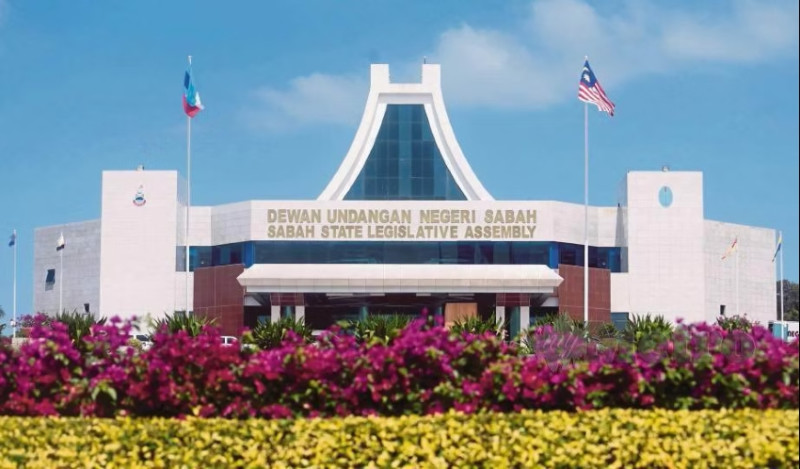

THE Sabah Legislative Assembly passed the Climate Change and Carbon Governance Enactment 2025 to assert the state control over carbon rights and emissions regulation, with added protections for native land and communities.
The Bill, tabled by Assistant Minister in the Chief Minister’s Department Datuk Abidin Madingkir, establishes a legal framework for carbon rights registration, emissions reporting, carbon trading, and project oversight.
It will also establish the Sabah Climate Action Council and the Sabah Climate Registry, backed by a climate fund financed through levies, royalties, and carbon-related fees.
Responding to concerns raised by several assembly members during the debate, Abidin assured the House that Free, Prior and Informed Consent (FPIC) would be respected in all carbon activities affecting native customary land.
“The principle of FPIC is indirectly established through the requirement for community involvement and valid approval before any carbon activity can be carried out on customary land,” he said.
“Its implementation will be detailed in the regulations and standard operating procedures (SOPs) after the enactment is passed and gazetted.”
He also clarified that proof of community engagement will be mandatory in feasibility studies for any carbon project near or on native customary areas.
“This community involvement is a compulsory prerequisite and will be strengthened through regulations to be determined later by the Minister.”
On concerns raised by Kapayan assemblywoman Jannie Lasimbang, Abidin confirmed that no carbon rights would be issued without formal registration and project approval.
“Every carbon project must undergo a feasibility study approved by the Council. Carbon rights can only be granted through a certificate once formally registered.”
Lasimbang had earlier warned the Assembly against repeating past mistakes, drawing parallels to the Nature Conservation Agreement (NCA), which was signed in 2021 without legislative approval or monitoring mechanisms.
The Bill also aims to ensure that rural landowners or smallholders are not negatively impacted. Abidin stressed that the law will not interfere with existing land or fishing rights unless the landowner voluntarily chooses to undertake a carbon project.
“The right to use land for agriculture or access the sea will not be affected by this enactment,” he said.
“These provisions only apply if landowners voluntarily choose to implement carbon projects to generate credits.”
Warisan’s Tungku assemblyman Datuk Mohd Assaffal P. Alian reserved his support to the bill in principle and warned that Sabah’s control over marine carbon assets could be challenged unless the Assembly formally rejects federal laws such as the Territorial Sea Act 2012 and Continental Shelf Act 1966.
He also raised concerns over the Ambalat block and the Sulawesi Sea Treaty.
Abidin said the bill reflects Sabah’s leadership in environmental policy and commitment to long-term climate resilience.
“This law shows that the Sabah government is fully committed to addressing climate change in a strategic and comprehensive manner,” he said.
“With transparent and inclusive implementation, this enactment can become a key driver of sustainable development for the state.”
The Bill’s passage comes as Sabah and Sarawak remain excluded from the federal Carbon Capture, Utilisation and Storage (CCUS) Act, which applies only in Peninsular Malaysia.
It also follows official confirmation that Sabah absorbs more carbon than it emits, placing the state ahead of global expectations under the Paris Agreement.
Sabah is estimated to contribute about 36% of Malaysia’s total carbon absorption and that the state is among a group of small regions worldwide with net sink status, which means it absorbs more greenhouse gases than it emits. – July 8, 2025