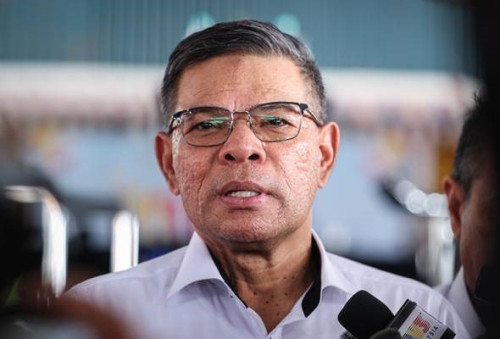
THE heated dispute surrounding PETRONAS’ legal action against PETROS has the potential to fracture national unity if it strays from the King’s decree for moderation and maturity in political debate, according to Pasir Gudang Member of Parliament Hassan Abdul Karim.
Hassan highlighted that His Majesty Sultan Ibrahim, King of Malaysia, has consistently emphasised the need to prioritise national interests while respecting the rights of the states, cautioning that the recent rhetoric from certain lawmakers risks driving confrontation rather than constructive resolution.
His comments follow sharp statements from leaders of Gabungan Parti Sarawak (GPS) and Gabungan Rakyat Sabah (GRS), who questioned PETRONAS’ actions and the Federal Government’s commitment to the Malaysia Agreement 1963 (MA63).
Puncak Borneo MP Willie Mongin accused PETRONAS of acting arrogantly and questioned whether the company had federal approval to pursue legal action, while Sri Aman MP Doris Sophia Brodie asked if the Prime Minister had authorised the move.
The debate intensified when Batang Lupar MP Shafizan Kepli suggested that the situation resembled “the government suing itself,” and remarks attributed to Minister of Works Datuk Seri Alexander Nanta Linggi regarding a possible “divorce” from Malaysia circulated widely.
Hassan warned that such language risks diverting attention from the substantive issues.
“When federal–state disputes are framed as betrayal, arrogance, or existential threat, we lose the spirit of federation,” he said. “That is exactly what the Agong cautioned against.”
He stressed that prioritising national interests does not negate state rights, but it must not involve measures that could weaken key national institutions.
“Specifically, approaches that could effectively ‘kill the golden goose’ by undermining PETRONAS’ commercial role in the name of asserting state authority are dangerous,” Hassan said.
“National interests are not protected by destroying an institution that underpins Malaysia’s energy security and fiscal strength. Protecting state rights must go hand in hand with safeguarding PETRONAS as a national asset.”
Hassan also warned that proposals seeking to diminish PETRONAS’ operational role, such as calling for a single-state gas aggregator model, risk long-term damage not only to the company but to the federation as a whole.
“You cannot strengthen Malaysia by weakening its backbone,” he said. “That is not federalism; that is self-inflicted harm.”
The dispute centers on Sarawak’s push for greater regulatory control over oil and gas activities through state laws and PETRONAS, including its ambition to act as the sole gas aggregator in the state.
PETRONAS, through several subsidiaries, has taken the matter to court seeking clarity on whether it must comply with certain state-level requirements and penalties amid overlapping claims under the federal Petroleum Development Act 1974 (PDA) and the Gas Distribution Ordinance 2016 (DGO).
Hassan emphasised that disagreements over oil and gas governance should not be misinterpreted as disrespect for MA63, nor should they be equated with allegations that the foundations of Malaysia are being dismantled.
“The federation is designed to manage tensions through institutions and dialogue, not political escalation,” he said.
Acknowledging long-standing grievances in Sabah and Sarawak, particularly concerning revenue sharing and autonomy, Hassan urged all leaders to exercise responsibility in de-escalating tensions.
“When leaders speak in absolutes, the room for compromise disappears,” he said.
He called on all parties to focus on safeguarding national unity while continuing discussions on state rights, revenue sharing, and autonomy within the constitutional framework.
“The Agong’s directive is not merely symbolic,” Hassan said. “It is a reminder that moderation is an obligation, not an option.” - January 30, 2026