


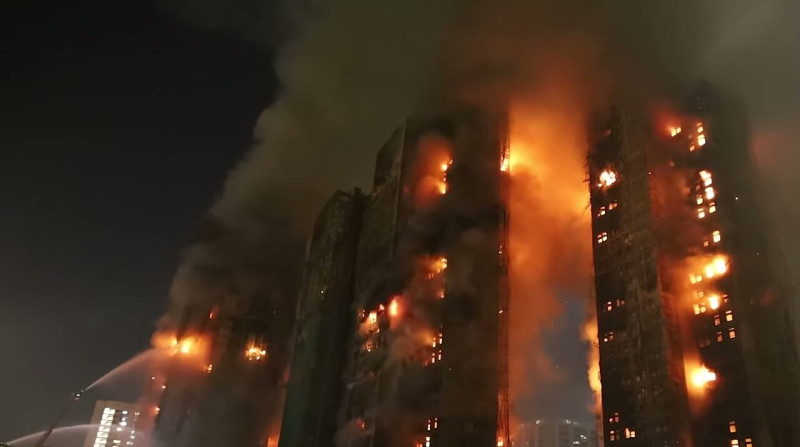
A YEAR after a devastating fire claimed 168 lives at Hong Kong's Wang Fuk Court housing complex, survivors and bereaved families continue to grapple with grief, displacement and unanswered questions over the disaster.
For 68-year-old Yip Ka Kui, the loss of his wife, Pak Sui Lin, has been particularly difficult to accept.
Despite her death in the November 2025 inferno, Yip continues sending her voice messages and photographs through WhatsApp, telling her how much he misses her.
“I just felt that maybe she'd gone out somewhere, or was away on a trip, so I kept talking to her every day,” Reuters cited him saying.
Six months ago, Yip returned to the charred apartment where the couple had lived for more than 20 years. Carrying a bouquet, he stood in the darkness and called out: “Don't stay here. Go wherever you want to; you're free now.”
He now lives with his elder son.
The fire, the deadliest in Hong Kong since 1948, swept through seven of the estate's eight 31-storey residential blocks in Tai Po district, where renovation works were underway and buildings were covered with scaffolding and protective netting.
Thousands of residents were displaced after their homes became uninhabitable.
As the disaster's first anniversary approaches, former residents are expected to return to the estate on Thursday to commemorate those who died.
The residential towers remain vacant, with their blackened facades visible behind security fences and under police patrols.
Hong Kong Chief Secretary Eric Chan said the government would not organise official memorial events but would not prevent citizens from holding lawful commemorations.
“If any destructive acts occur, we will of course enforce the law,” he said in a radio interview.
In the aftermath of the fire, Beijing had warned against any “anti-China” protests, while authorities shut down an online petition demanding an independent investigation as public anger mounted over missed fire safety warnings and alleged unsafe construction practices.
For survivors and bereaved families, the past year has also involved prolonged emotional and physical strain.
Phyllis Lo, 49, who lost her mother in the fire, said she had spent much of the year mourning, attending hearings conducted by a judge-led investigative panel and following discussions on long-term housing arrangements.
“I lost part of my youth. In the past year I spent so much time following the hearings and watching the news; I had to put my own work aside,” she said.
The government has offered homeowners a buyback scheme and access to replacement subsidised housing, with most owners accepting the proposal, which authorities consider the quickest way to help residents rebuild their lives.
However, the government has ruled out rebuilding the estate at its original site, citing the lengthy process involved.
Lo said she remained unconvinced that the proposed arrangements would help her move on.
“I lost a root. This is my family home. I have lived here for 40 years; it was a place I could fall back on when something happened.”
Last month, Hong Kong leader John Lee released an independent report which found four government departments partly responsible for the disaster and announced the resignation of Housing Secretary Winnie Ho, the first official to step down over the fire.
Lee also pledged sweeping reforms to the building industry and regulatory system, including legislation to criminalise bid rigging in the city's lucrative building renovation sector.
However, Yip said the measures had done little to ease his sense of injustice.
“Why is it that mistakes made by certain individuals and the inaction of some government departments led to such a major disaster, yet it is us, the victims, who are left to pay the price?” he said. - November 25, 2026











