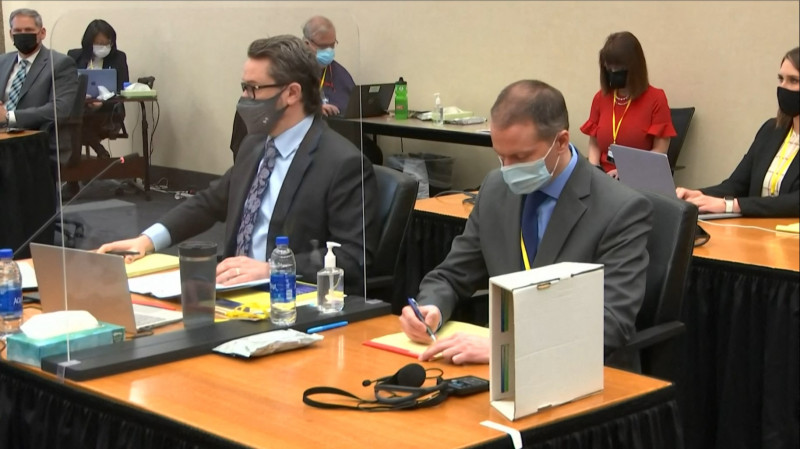
MINNEAPOLIS – George Floyd’s death unleashed a fierce debate in the United States over reforming the police, but the trial of the officer accused of his murder has steered clear of putting the force itself on the stand.
Protests erupted across the country when footage emerged of Floyd dying after officer Derek Chauvin knelt on his neck, with many saying the incident revealed systematic police brutality and racism.
Calls have grown for fundamental change in how police operate and their apparent immunity, with the “defund the police” movement demanding that money instead be diverted to social justice programmes.
In the calm of the Minneapolis courtroom, however, legal proceedings have focused on whether Chauvin was guilty of murder or manslaughter when Floyd died on May 20, 2020.
“There is no political or social cause in this courtroom,” Chauvin’s attorney, Eric Nelson, told the jury at the start of the trial, while prosecuting attorney Jerry Blackwell struck a similar note saying “this case is not about all police”.
Chauvin, who is white, was seen in the phone video kneeling on the neck of Floyd for more than nine minutes as the African-American man complained repeatedly that he “can’t breathe”.
His death – and the role of the US police – became a battleground issue in last year’s election, as some Black Lives Matter protests turned violent, and then-president Donald Trump sought to portray himself as a “law and order” leader.
Keen to distance the force from the alleged misconduct of one officer, police testifying at the trial have painted Derek Chauvin as a black sheep who acted unprofessionally.
‘Not part of training’
“That, in no way, shape or form is anything that is by policy,” Minneapolis police chief Medaria Arradondo told the court this week, a rare case of one officer testifying against another.
“It is not part of our training and it is certainly not part of our ethics or our values,” he added.
Katie Blackwell, who headed the police training unit, was asked if Chauvin had used an approved neck restraint.
“I don’t know what kind of improvised position that is,” she said. “It’s not what we train.”
Richard Zimmerman, the longest-serving officer in the Minneapolis Police Department, described Chauvin’s use of force as “totally unnecessary”.
“Pulling him down to the ground face down and putting your knee on a neck for that amount of time – it’s just uncalled for,” he said.
Chauvin was sacked after the incident, but witnesses’ evidence was a crumbling of the infamous “blue wall of silence” when police protect their colleagues from misconduct allegations.
Chauvin’s union also supported his sacking, while Minneapolis city reached a US$27 million (RM111.6 million) “wrongful death” settlement with Floyd’s family just before the trial.
In similar controversies there is often an “instinctive reaction to protect a brother officer, but we didn’t see that here”, said Ashley Heiberger, a former officer who now works as an advisor on police practices.
“Every time you saw a comment from police about that, it was negative.”
Since Floyd’s death, some cities have banned police chokeholds, and others made police disciplinary records accessible to the public or beefed-up police training.
But, federal reform on police immunity was buried by the Senate, and proposed cuts to the New York police budget were reduced and spread over time.
Local activists in Minneapolis have also questioned police claims during the trial that the force has already learnt lessons and changed practices.
For Kate Levine, a professor at the Cardozo School of Law in New York, the lack of police support for Chauvin could be a strategy to avoid the loud calls for much-needed reform.
“My concern is that Derek Chauvin gets convicted, and the police department that he works for says: ‘this guy was a bad apple, otherwise, we have no problems’,” she said. – AFP, April 7, 2021