World

UK trial reinfects volunteers who have had coronavirus

University of Oxford’s ‘first-of-a-kind’ tests funded by the Wellcome Trust

Updated 5 years ago · Published on

UK trial reinfects volunteers who have had coronavirus
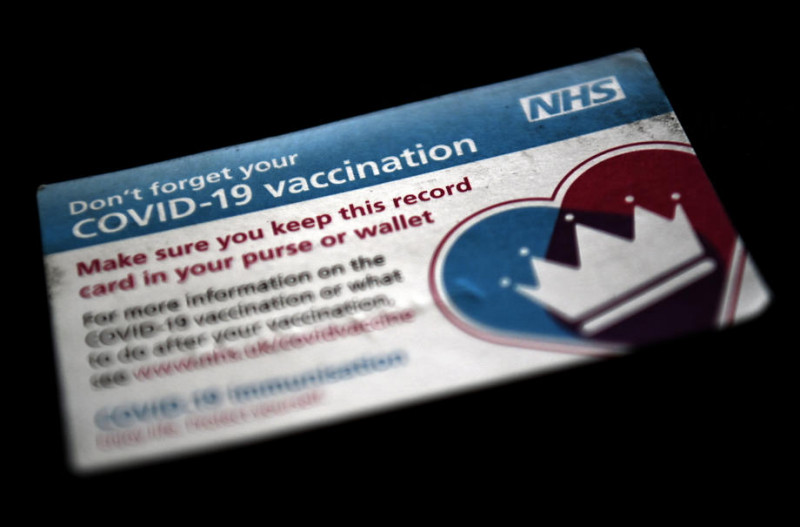
A Covid-19 vaccination card in London, Britain. The University of Oxford is studying the immune responses of people who have already had Covid-19 are deliberately reinfected. – EPA pic, April 20, 2021

LONDON – The University of Oxford said yesterday it has launched a trial in which people who have already had Covid-19 are deliberately reinfected.

The carefully controlled study will look at the kind of immune response mounted by the volunteers.

The scientists will know “exactly when the second infection occurs, and exactly how much virus they got”, Helen McShane, a professor of vaccinology, said in a statement.

She said the trial “may help us to design tests that can accurately predict whether people are protected” after a prior infection.

Anyone who suffers symptoms will receive the Regeneron antibody treatment used to treat Covid-19 patients.

The University of Oxford’s “first-of-a-kind” tests are funded by the Wellcome Trust.

At the start of the trial, up to 64 fit and healthy volunteers aged 18 to 30 will be deliberately reinfected with the original Wuhan strain.

They will be quarantined for at least 17 days in a special hospital suite, having lung and heart scans. They will then have follow-up appointments and be monitored for a year.

“This study has the potential to transform our understanding by providing high-quality data,” said Shobana Balasingam, vaccines senior research adviser at Wellcome.

The trial’s initial phase will look at the minimum dose that allows the virus to start replicating without symptoms in some 50% of volunteers.

Then, in the second phase, another group of volunteers will all receive this established minimum dose.

The trial comes as a hospital here has isolated a group of healthy volunteers while exposing them to the virus, in a world first.

That began last month and is being carried out in collaboration between Imperial College London and the company hVIVO at the Royal London Hospital. 

Those who have been infected in a controlled way are monitored to see how their illness progresses and how drugs and vaccines could work against it. – AFP, April 20, 2021
Related News

Community / 17h

BOH contributes RM50,000 to Malaysia’s homegrown cancer vaccine research

Events / 2w

UKM to establish academic research platform named after Dr Wan Azizah

Malaysia / 4w

Kedah: The ancient Malay kingdom challenges the conventional narrative of Malayan history

Education / 3mth

CityUHK, Sunway University discuss research, higher education cooperation

Health / 3mth

KPJ Healthcare, SingHealth to collaborate on healthcare training, research

Malaysia / 6mth

Covid-19 cases in Malaysia stable, no deaths recorded this year – MOH

Spotlight

Malaysia

Anwar receives special recognition as 10,000 Muslims gather in Putrajaya

Malaysia

Video of elderly man being assaulted goes viral on social media

Malaysia

The wide reach of corruption and organised crime in the country

Malaysia

Malaysia pushes to give smaller economies stronger voice in Asia-Pacific trade – Anwar

Malaysia

No tsunami threat to Malaysia after 5.4-magnitude earthquake hits Banda Sea

Malaysia

Who is calling the shots in Negeri Sembilan as Ismail’s position comes under scrutiny?

Opinion

Ayob Khan: When the uniform comes off, the principles remain

Malaysia

MySiren to send emergency alerts to compatible phones nationwide from Nov 29 test

You may be interested

World

US weighs new tariffs on 16 trading partners, Malaysia faces 19% rate cap

World

US attorney-general declines to confirm whether Nvidia CEO was investigated

World

UN climate talks collapse as EU rejects ‘weak’ COP31 deal

World

Trump backs Jensen Huang's return as Nvidia CEO amid national security scrutiny