ROME – Bars, restaurants, cinemas and concert halls will partially reopen across Italy today in a boost for coronavirus-hit businesses, as Parliament debates the government’s €220 billion (RM1 trillion) European Union-funded recovery plan.
After months of stop-start restrictions imposed to manage its second and third waves of Covid-19, Italy hopes this latest easing will mark the start of something like a normal summer.
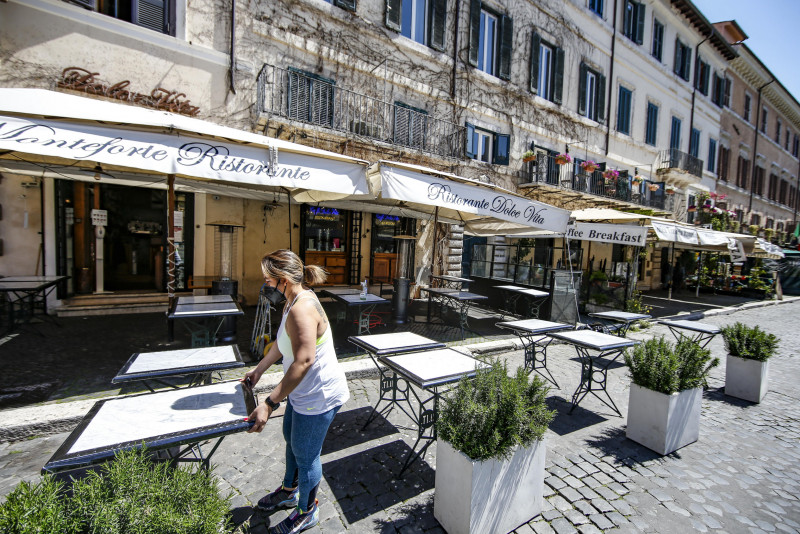
Three-quarters of regions will drop into the low-risk “yellow” category from today, with bars and restaurants permitted to restart table service outside – including, for the first time in six months, in the evening, although a 10pm curfew remains in place.
“Finally!” said Daniele Vespa, the 26-year-old head waiter at Baccano, an eatery near the Trevi Fountain here as he made preparations for the return of customers.
“Hopefully... we can soon reopen inside as well,” he told AFP, adding: “It’s the start of a return to normality.”
Cinemas, theatres and concert halls can also open at 50% capacity, followed by the staggered reopening of swimming pools, gyms, sporting events and theme parks by July 1.
Prime Minister Mario Draghi has been under intense pressure from regional governments and increasingly regular street protests to ease restrictions, as Italy battles its deepest recession since World War II.
He has admitted to taking a “calculated risk” as infection rates and intensive care admissions fall, but deaths still mount at more than 300 every day to more than 119,000.
The vaccination programme is gaining pace with more than 17.5 million jabs administered so far in a population of around 60 million, but there are disparities between regions.
“Clearly, if the gradual reopening is interpreted as a ‘free-for-all’, a new surge in infections risks compromising the summer season,” warned Nino Cartabellotta, head of the GIMBE Foundation health think tank.
‘Necessary reforms’
Italy was the first European country to be hit by the pandemic in early 2020, and remains one of the worst affected, with the EU’s highest reported death toll and one of the deepest recessions.
The economy contracted by a staggering 8.9% last year, and a million jobs have been lost.
Italy is pinning its hopes on a €222.1 billion investment and reform plan funded largely by the EU. Rome is the biggest recipient of the bloc’s €750 billion post-pandemic recovery fund.
In Parliament today, Draghi will formally present the programme he hopes will boost growth by 3.6 percentage points by 2026, ahead of a Friday deadline to submit the package to Brussels.
In a statement yesterday, the government said the plan is a “historic intervention” to repair the damage caused by the pandemic and address “the structural weaknesses” of the Italian economy, while putting it on a greener footing.
Priorities include infrastructure, notably high-speed railways; green energy, including hydrogen power projects; investment in internet services; and, digitalisation.
There will be money to help women and young people, who have disproportionately lost out during the health crisis, while around 40% will be targeted at historically underperforming southern Italy.
Draghi, a former European Central Bank chief, has also highlighted the importance of reform, and the plan sets out an “ambitious programme” focused on modernising notably public administration and the snail-paced justice system.
Disputes over the spending plan brought down the previous prime minister and his coalition, after which Draghi was parachuted in to lead a national unity government in February.
His broad support in Parliament “gives him significant room for manoeuvre to deliver the necessary reforms”, said Jesus Castillo, an economist at Natixis. – AFP, April 26, 2021