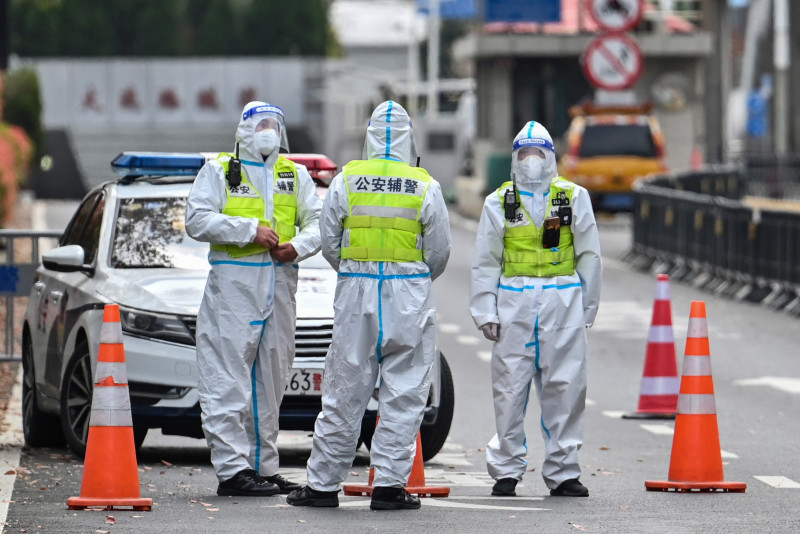
SHANGHAI – China reported more than 20,000 Covid-19 cases yesterday, the highest daily tally given since the start of the pandemic as millions in locked-down Shanghai began a new round of testing.
The country’s “zero-Covid-19” strategy has come under immense strain as cases spike, with around 25 million residents of Shanghai – China’s largest city and economic engine room – ordered to stay at home as the authorities struggle to contain the outbreak.
Until March, China had kept daily cases low with snap localised lockdowns, mass testing, and strict restrictions on international travel.
But the caseload has hit thousands per day in recent weeks, with Shanghai driving the surge of the highly transmissible Omicron variant.
The city locked down in phases last week and complaints have swelled online of fresh food shortages caused by logistics disruptions and panic buying, which has left many residents waking early to try to beat the queues on grocery apps.
State broadcaster CCTV reported that the city will launch a fresh round of tests on the entire population yesterday.
Shanghai’s “prevention and control situation is very severe,” National Health Commission official Lei Zhenglong said yesterday, adding the outbreak is still “in its peak phase.”
It was the latest dour warning suggesting a long run in lockdown may be ahead, while city health officials have converted a convention centre into a makeshift Covid-19 hospital for 40,000 people.
Grocery woes
China recorded 20,472 infections yesterday, according to the National Health Commission.
It is the country’s highest daily infection number given by authorities, even during the peak of the initial outbreak which centred around Wuhan.
The majority of the cases are, however, asymptomatic.
Authorities reported no new deaths, in a country which says only two people have died of the virus in nearly two years.
Yet China faces low vaccination rates, especially among the elderly, leaving officials with a high-wire balancing act of maintaining public health while keeping the economy moving.
Omicron can only be thwarted by vaccination “protecting high-risk populations like the elderly and those with underlying conditions,” Wang Guiqing, an infectious disease expert of Peking University said in yesterday’s press conference.
In Shanghai, quarantine facilities are bulging with people who test positive – even if they are asymptomatic – as city officials stick rigidly to virus protocols.
Those include separating Covid-19-positive babies and children from parents who test negative, a policy that has anguished worried families.
City officials said yesterday that parents of some child patients with “special needs” would now be allowed to remain with their Covid-19-positive children.
Anger over lack of fresh food and curtailed movements is rising among residents as officials extend what was originally intended to be a short lockdown.
The Weibo hashtag “buying groceries in Shanghai” was censored from the platform, even though many of the posts detailing residents’ efforts to nab coveted vegetables were still visible yesterday.
Shanghai, China’s largest city, accounted for more than 80% of the national tally, city officials said yesterday.
A top Shanghai official has conceded that the financial hub had been “insufficiently prepared” for the outbreak.
China, the country where the coronavirus was first detected in the central city of Wuhan in late 2019, is among the last remaining places in the world following a zero-Covid-19 approach to the pandemic.
The outbreak has taken on an increasingly serious economic dimension, with China’s factory output falling to its lowest in two years in March, according to independent indices released by Chinese media group Caixin. – AFP, April 7, 2022