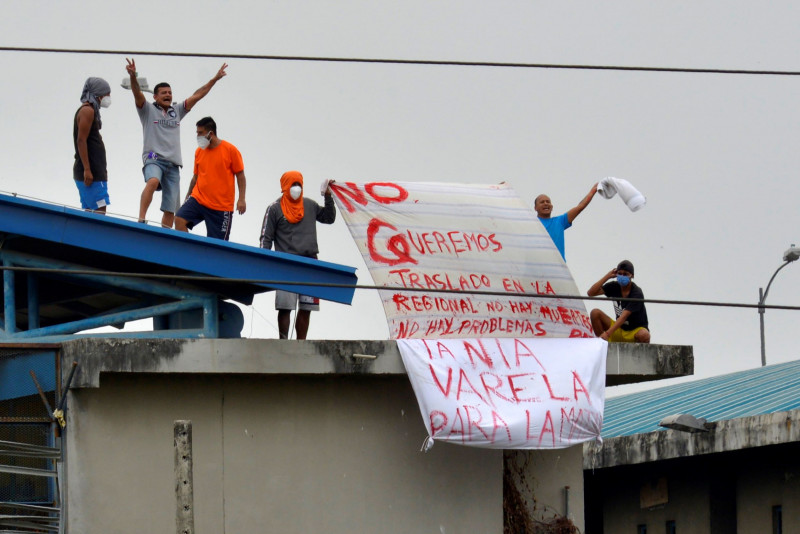
QUITO – After another bloody year in Ecuador’s interminable cycle of prison violence, authorities appear no closer to taking control.
The latest sordid massacre saw 20 inmates killed – some mutilated – last Sunday in the El Turi penitentiary in the southern city of Cuenca.
It was the fifth such mass murder in a prison riot since February 2021.
The government blames these horrors on drug gangs taking over prisons, but some experts claim authorities simply do not care about those caught up in the violence.
Vianca Gavilanes, a lawyer for the inmates’ rights NGO Dignity Foundation, blames “generalized apathy” towards the lives of prisoners and a government that has forgotten “its duties as guarantor”.
She noted that even in instances when intelligence networks or family members have warned of imminent bloodshed, authorities have been slow to take action.
“It seems as if the police are hoping they will die inside, that they will kill each other, and they only pick up the bodies,” Gavilanes said.
Lack of control
The modus operandi is always the same in these riots: a night-time brawl involving guns and machetes leaves a trail of dismembered bodies.
Criticised for not sufficiently addressing the issue, right-wing President Guillermo Lasso – in power for less than a year – has released additional funding for prisons and said extra guards would be hired.
He also created a commission to study the issue in December and its first report was damning.
Despicable conditions had turned prisons into “human warehouses and centers of torture,” the committee said.
Mayra Flores, a researcher at the Kaleidos Center, which has also analysed the penitentiary system, says “prison has always had a dynamic that is beyond state control.”
Previously, she argues, there were rules that favoured coexistence amongst inmates which allowed for more authorised freedoms, such as more flexible family visits.
But in 2014, new criminal penalties were introduced that broadened the number of crimes carrying prison sentences, which necessitated the construction of harder to control mega-prisons.
Police creating tensions
Despite the increased funding and increased number of inmates, prisons still have a lack of guards.
“The state itself is not giving it (the prison system) the priority that it should have and it (the state) has a very closed vision, very centred on the war against drugs,” Flores said.
Lasso insists the problem inside the facilities mirrors that outside where drug gangs are vying for control of drug trafficking routes.
Situated between Colombia and Peru – the two largest producers of cocaine in the world – Ecuador seized a record 210 tons of drugs in 2021.
Interior Minister Patricio Carrillo recognizes, though, that “there is corruption within the penitentiary system” and that “the Ecuadoran state has been humiliated by the mafias” who have managed to bring in and traffic weapons within prisons.
Flores argues that the police, through its intelligence arm, is “creating tensions in jail” by giving privileges to those that offer up information about gang activities within prison.
The benefits provoke arguments between inmates that “transform into violence.”
Punishing the poor
In its report, the commission created by Lasso said prisons “have become youth holding centres.”
Three-quarters of inmates are aged 18 to 35, it said.
Flores points out that the anti-drug campaign mostly punishes young people from poor neighbourhoods, where work and study opportunities are lacking.
“What are they punishing? They’re punishing poverty because in the end those are the people cramming the prisons,” said Flores. – AFP, April 7, 2022