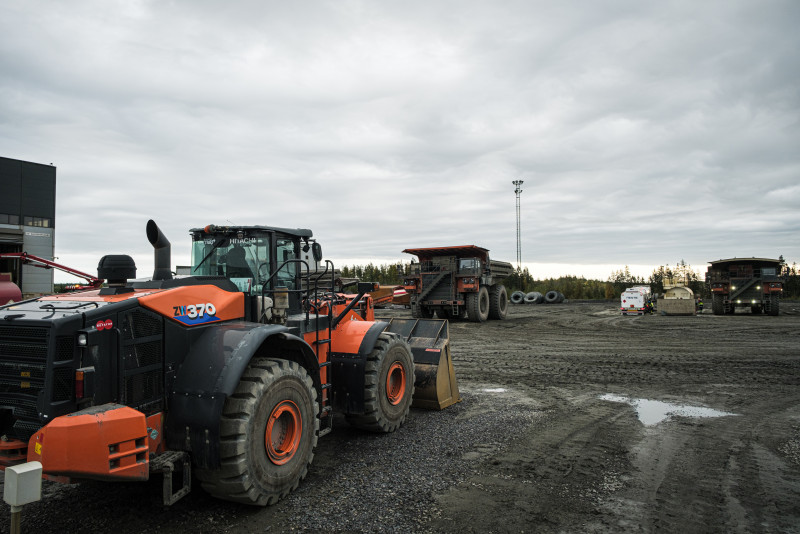
SOTKAMO, Finland – Lines of trucks carrying piles of rock crisscross Finland's rugged Terrafame mine, which sits 300km (186 miles) below the Arctic Circle and is Europe's largest source of nickel for electric car batteries.
At the immense, 60 square kilometre site, the extracted stone is crushed, heaped into vast mounds and fed with oxygen and water through red hoses, allowing the nickel, along with some cobalt, to gradually leach out.
“Even today more than 50%of our turnover is coming from the electric vehicle value chain,” Terrafame said chief executive officer Joni Lukkaroinen.
Finland is the only EU country whose bedrock is known to contain all the major battery minerals – including cobalt and lithium – and the Nordic nation is drawing up plans to exploit these resources in order to become a major industry player.
Yet the prospect of increasing mining is controversial in sparsely populated Finland, whose vast forests, diverse wildlife and pristine lakes are prized national assets.
As Europe looks to counter Asia's dominance in the fast-growing sector, Finland is one of the most active member states vying for a share of the lucrative battery business, but competition between EU countries is fierce.
Finland's government has promised 300 million euros ($353 mn) in stimulus for the battery industry this year, and seven new excavation sites are among the commercial projects now underway to try and create a “battery cluster”.
Mika Nykanen, charged with drawing up the government's “battery strategy”, said the Nordic country’s approach “will be strongly grounded in sustainability and Finland's climate policy goals.”
But campaigners are worried that expanding mining in Finland will destroy sensitive ecosystems.
“You simply cannot produce these minerals in an environmentally friendly way," said campaigner Antti Lankinen, standing in front of a towering pile of waste rock on the perimeter of the Terrafame site in Sotkamo, central Finland.
Lankinen has worked with the Finnish Association of Nature Conservation to try and force Terrafame to change how it stores the waste rock, which it argues can cause acid runoff into the adjacent landscape if exposed to rainwater.
The mine’s previous owners, Talvivaara, were prosecuted after an ecological catastrophe in 2012 when uranium and other toxic metals leaked into local waterways.
However Joni Lukkaroinen, CEO of new owner Terrafame, said there have been no environmental issues since his firm took over the mine five years ago.
“We do have environmental impacts, but those impacts are in line with our permits," said Lukkaroinen.
Elsewhere in Finland, campaigns have sprung up against new extraction in Lapland and in the Saimaa lake district, a tourism hotspot known for its unique wildlife.
"Lake Saimaa is Europe's fourth largest freshwater system and is not a suitable area," said campaigner Miisa Mink, adding that four new prospecting permits have been granted in the area since May.
“If we're not careful, sure we’ll have electric cars but we won’t have fresh water.”
Yet battery industry leaders insist that Finland is a global pioneer in sustainable practices, and believe this will give it an advantage over its competitors.
Terrafame’s mining methods, for instance, create a 60% smaller carbon footprint than traditional practices, the firm says.
Meanwhile, Finnish mines are bound by much tougher standards than in the Democratic Republic of Congo, where more than half the world's cobalt is produced in conditions rife with child labour and human rights abuses, according to NGOs.
“There is no point buying an electric vehicle produced from raw materials that aren’t sustainable,” said Finnish Minerals Group CEO Matti Hietanen.
Despite Finland recently losing out to Sweden to host Northvolt with its US$1 billion (RM4.12 billion) “gigafactory” that is part-funded by Volkswagen, other foreign firms are choosing to locate to Finland, including Germany’s BASF and Belgium’s Umicore.
Terrafame will also open a €240 million (RM1.16 billion) refinery next year, producing enough nickel sulphate for 1 million electric vehicles, and cobalt sulphate for 300,000. – AFP, November 16, 2020