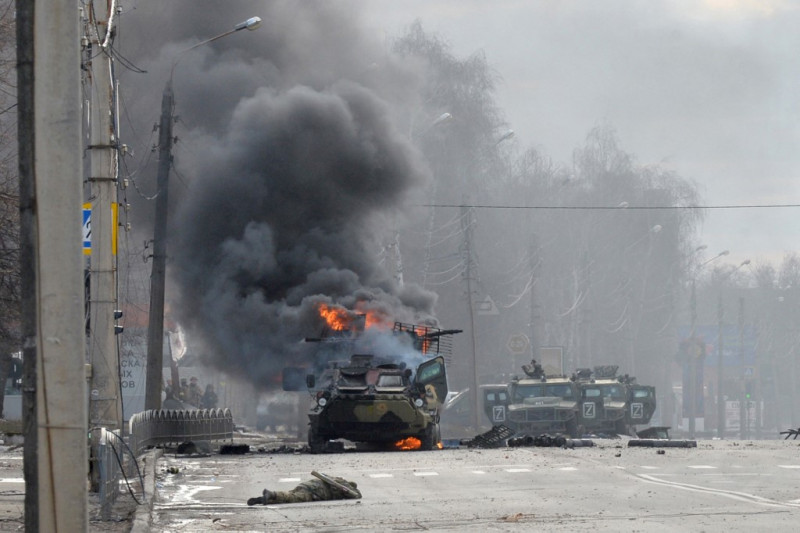
PARIS – Ukraine is urging allies for more weapons to fight Russia but experts warn the West is struggling to produce enough ammunition for the arms it has already donated to Kyiv.
“The war in Ukraine is consuming an enormous amount of munitions, and depleting allied stockpiles,” Nato chief Jens Stoltenberg told journalists yesterday.
“The current rate of Ukraine’s ammunition expenditure is many times higher than our current rate of production. This puts our defence industries under strain.”
Stoltenberg admitted that the Western military alliance is facing a “problem”, as waiting times for large-calibre ammunition have grown from 12 to 28 months.
The West has pledged billions in military aid since Russia invaded its neighbour almost a year ago, but fighting along hundreds of kilometres of active frontline has depleted ammunition reserves.
It is not immediately clear how many munitions exactly the Ukrainian armed forces have spent over the past months.
But a French military source estimated that the Russians fired up to 50,000 artillery shells a day in the month of July, while the Ukrainians fired back some 6,000.
And Ukrainian munition appetite is thought to have greatly increased after Kyiv’s forces launched a counter-offensive at the end of August.
As fears grow that Moscow is gearing up for a fresh offensive in the coming weeks, Kyiv will likely need more munition than ever to defend itself.
Peak production
Since the start of the year, Ukraine has secured pledges from its Western allies that they will send heavy battle tanks and is now also pleading for fighter jets – so far without success.
“Before even speaking about jets and tanks, let’s first try to best ensure customer service for those weapons we have already delivered,” said a French governmental source.
That included both providing enough munition and keeping the arms in good working condition, the source said.
The United States alone has sent Kyiv 1,600 Stinger surface-to-air missiles and 8,500 Javelin anti-tank missiles, according to the US State Department.
That is the equivalent of 13 years of production for the Stingers, and five years of work for the Javelins, the head of US defence firm Raytheon Technologies, Greg Hayes, warned in December.
Even partnering with fellow American arms company Lockheed Martin to increase production, they could only produce 400 Javelin missiles per month.
French arms industry firm Nexter Systems has an annual production capacity of several tens of thousands of 155-mm artillery shells, but a high-ranking member of the military said the group has “almost reached its limit”.
For decades following the fall of the Berlin Wall and the collapse of the Soviet Union, the West cut its defence spending.
Leo Peria-Peigne, a researcher at the French Institute of International Relations, said the West is slowly gearing up to restock ammunition supplies.
But “it will depend on whether states are prepared to make the financial effort,” he said.
Wholly inadequate
Ultimately, said William Alberque, an expert at the International Institute for Strategic Studies, “the Western defence industry is not ready for war”.
“Our defence industry – ammunition, logistics, supplies, training – is wholly inadequate to the task,” he said, adding it is not ready for longer conflicts.
The West needs a better “defence industrial plan”, he said, not just because of the war in Ukraine, but to be prepared for any escalations in other parts of the world, to be able to stand up to Russia, China, or even Iran and North Korea.
Ivan Klyszcz, a research fellow at the Estonia-based International Centre for Defence and Security, agreed the post-Cold War model was showing its “shortcomings”.
Within Nato, Poland, Romania and the Baltic states could possibly help produce ammunition for the Soviet equipment Ukraine still uses alongside the Western weapons, he said.
But he said contacts were also being made with nations outside the alliance like South Korea, Morocco, Jordan and Pakistan.
“Short-term solutions will have to come from abroad,” Klyszcz said.
“Everything else will take months and months.” – AFP, February 14, 2023