ANTOFAGASTA – Starving microorganisms capable of surviving in extreme conditions have already managed to “eat” a nail in just three days.
In Chile, a scientist is testing “metal-eating” bacteria she hopes can help clean up the country’s highly polluting mining industry.
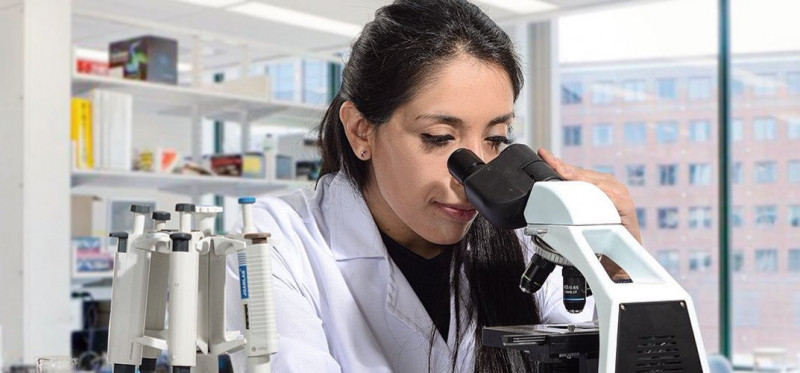
In her laboratory in Antofagasta, an industrial town 1,100km north of Santiago, 33-year-old biotechnologist Nadac Reales has been carrying out tests with extremophiles – organisms that live in extreme environments.
Reales came up with her idea while still at university as she was conducting tests at a mining plant using microorganisms to improve the extraction of copper.
“I realised there were various needs in the mining industry, for example what happened with the metallic waste,” she told AFP.
Some metals can be recycled in smelting plants but others, such as HGV truck hoppers that can hold 50 tons of rock, cannot and are often discarded in Chile’s Atacama Desert, home to the majority of the country’s mining industry.
Chile is the world’s largest producer of copper, which accounts for up to 15% of the country’s GDP, resulting in a lot of mining waste that pollutes the environment.
In her research, Reales, who now runs her own company Rudanac Biotec, concentrated on iron-oxidising bacteria called Leptospirillum.
She extracted the bacteria from the Tatio geysers located 4,200 metres above sea level, some 350km from Antofagasta.
The bacteria “live in an acidic environment that is practically unaffected by relatively high concentrations of most metals,” she said.
“At first the bacteria took two months to disintegrate a nail.”
But when starved, they had to adapt and find a way of feeding themselves.
After two years of trials, the result was a marked increase in the speed at which the bacteria “ate”, devouring a nail in just three days.
Surprising benefit
Reales says “chemical and microbiological tests” have proved the bacteria are not harmful to humans or the environment.
“We’ve always seen a lot of potential in this project that has already passed an important test in the laboratory,” said Drina Vejar, a microbiologist who is part of a four-person team working with Reales.
“It’s really necessary at this time when we have to plan for a more sustainable development, especially in all these cities with so many polluting industries.”
Mining companies have shown interest in the research but while Rudanac Biotec previously benefitted from a state fund for start-ups, the company needs investment to move on to its next stage of trials.
Reales says she needs money to see if her method will “eat a medium sized beam or a hopper”.
When the disintegration process is complete, what remains is a reddish liquid residue, a solution known as a lixiviant that itself possesses a surprising quality.
“After biodisintegration, the product generated (the liquid) can improve the recovery of copper in a process called hydrometallurgy,” said Reales.
Essentially, the liquid residue can be used to extract copper from rock in a more sustainable manner than the current use of chemicals in leaching.
Reales says it means green mining is “totally feasible”.
That is of great interest to mining companies that could use it to improve their large-scale extraction of copper or other minerals, while also reducing their pollution, something they are required to do by law.
Reales recently submitted a request for an international patent for her technology, but more importantly she hopes it will help reduce metal waste blotting the landscape in the mining regions of her country. – AFP, October 9, 2021