SINGAPORE – Bangladeshi migrant worker Md Sharif Uddin used to spend his days off with friends outside his cramped Singapore dormitory, but coronavirus curbs have for 18 months left him stuck inside during his spare time.
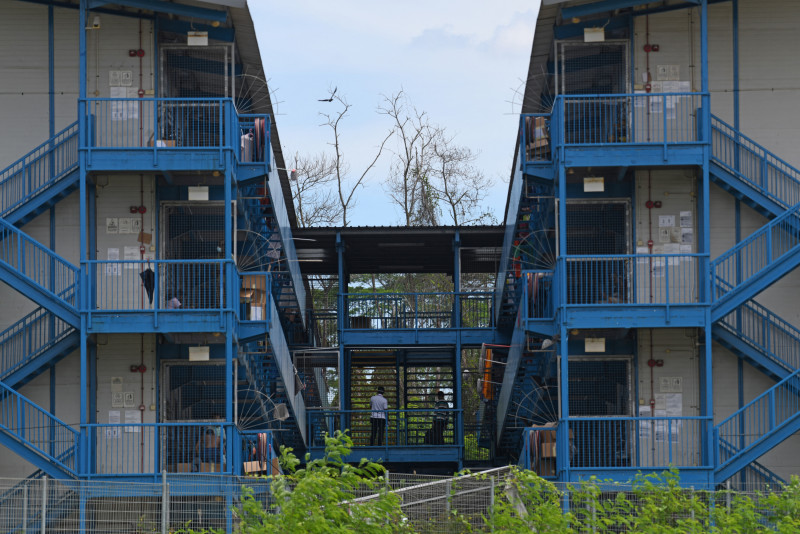
More than 300,000 migrant workers, many of them from South Asia, live in dorms in the prosperous city-state, where they are typically packed into shared rooms and sleep on bunk beds.
The vast complexes were hit by Covid-19 and locked down at the start of the pandemic, while restrictions were introduced across the whole country for a period to prevent a broader outbreak.
Curbs have been eased for most in Singapore, where despite currently facing a renewed virus wave – vaccinated people can go out shopping and to restaurants, and borders are gradually reopening.
But it is a different story for the low-paid migrants, who remain subject to far more onerous restrictions that mostly allow them to travel only between their work and accommodation.
“It’s a very painful life... like prison,” said construction site worker Uddin, adding that before the pandemic he used to meet friends at the weekend to drink coffee, recite poetry and gossip.
“We’re only allowed to go to work and home, back and forth, and nowhere else. It’s like living under house arrest,” added the 43-year-old, who has worked in Singapore for 13 years and written two books about his experiences.
Beyond heading to work, the migrants are allowed occasional trips to specially built “recreation centres” that typically comprise shops set around a square, and sports facilities.
Economic commodity
When the dormitories – self-contained and usually in out-of-the-way parts of Singapore – became the epicentre of the city’s first Covid-19 wave last year, it sparked national soul searching.
Calls mounted to improve the livelihoods of migrants who have for decades done the back-breaking work of constructing the financial hub’s gleaming skyscrapers, cleaning housing estates and maintaining public transport.
The government pledged to take steps such as building new dormitories with more modern facilities and more space for residents.
But the continued restrictions faced by the workers – who typically earn from SG$500 to $1,000 (RM1,500 to RM3,000) a month in one of the world’s most expensive cities – highlight how little has changed in reality, critics say.
“Our government doesn’t quite see them as fully human,” Alex Au, vice-president of migrant rights group Transient Workers Count Too, told AFP.
Authorities treat the migrants like “an economic commodity”, and fail to “accord them the same rights, the same freedoms that our citizens have,” he said.
As criticism mounted, authorities in the city-state of 5.5 million started a scheme that allows a limited number to make organised trips to designated areas.
About 700 participated in the scheme’s first month in September, and it was expanded at the end of last month to allow up to 3,000 workers a week from the dorms to participate.
But this still represents only a tiny proportion of the workers.
Psychological problems
The government maintains that continued curbs on migrants – who come from countries including Bangladesh, India and China – are necessary as there is a higher risk of virus transmission due to their living conditions.
This is despite the fact 98% of dorm residents have been fully vaccinated, higher than the city-state’s overall rate of 85%.
“Any easing of movement restrictions will need to be done in a careful and calibrated manner,” Manpower Minister Tan See Leng told Parliament last week.
He also said authorities have improved access to mental health services.
But this is little comfort for dorm resident Amir from Bangladesh, who longs to have the freedom to go where he wants.
“I miss nature, open space,” said the 32-year-old construction site supervisor, who spoke using a pseudonym.
“We can only see our dormitory life and our construction site. We cannot travel... cannot see the outside.”
For Uddin, change can’t come soon enough for the increasingly stressed migrant workers.
“We are facing psychological problems,” he said, adding their “fundamental rights as workers and human beings” had been breached.
“This imprisoned lifestyle won’t let a person live a healthy life.” – AFP, November 13, 2021