WASHINGTON – A Chinese invasion of Taiwan would likely fail if the United States helps defend the island – but at a debilitating cost to the American military itself, according to a US think tank today.
Military experts brought together by the Centre for Strategic and International Studies to wargame the conflict said every likely direct participant in a war – the US, China, Taiwan, and Japan – would experience “enormous” losses.
Chinese missiles would likely destroy US air bases in Japan and as far as Guam, and sink two US aircraft carriers and between 10 and 20 destroyers and cruisers as the invasion opened.
But the Chinese invading force itself would be heavily destroyed before it ever occupied any significant part of Taiwan.
Ultimately it would be prevented from its goal of capturing the island’s capital Taipei, according to most scenarios tested.
That, as well as damage incurred on mainland targets from Taiwanese counterattacks, could destabilise Chinese Communist Party rule, the report says.
“We reached two conclusions,” said Eric Heginbotham, a security expert at Massachusetts Institute of Technology.
“First, under most circumstances, China is unlikely to succeed in its operational objectives, or to occupy Taipei,” he said.
“Second, the cost of war would be high for all involved, certainly to include the United States.”
The wargaming tested 24 different scenarios focused on China attempting to seize the island by invasion in 2026.
Crucial was the US: without America’s help, Taiwan would be conquered by the People’s Liberation Army in three months or less.
The wargame assumed the invasion would begin with an opening bombardment by China that destroys most of Taiwan’s navy and air force in a few hours.
The Chinese navy would encircle Taiwan and begin ferrying a landing force of thousands of PLA soldiers and their equipment across the Taiwan Strait.
In what the wargamers called the most likely scenario, Taiwan’s army would bog the invaders down on the coast.
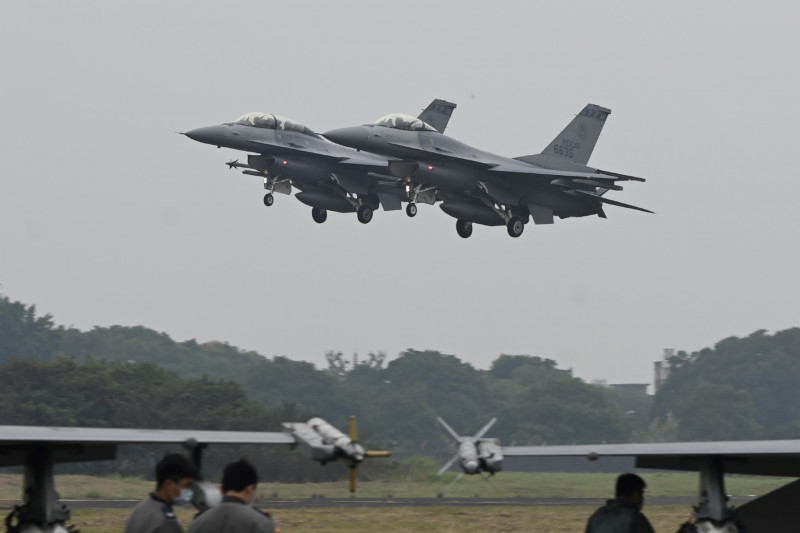
“Meanwhile US submarines, bombers, and fighter/attack aircraft, often reinforced by Japan Self-Defence Forces, rapidly cripple the Chinese amphibious fleet,” the report said.
“China’s strikes on Japanese bases and US surface ships cannot change the result: Taiwan remains autonomous,” it said.
Pyrrhic victory?
Matthew Cancian of the US Naval War College said there were crucial variables on which that success depends.
First, he said, Taiwan itself must be determined to fight back.
Secondly, Japan must give its permission for the US to launch counterattacks from its bases on Japanese territory.
Without that, Cancian said, “then the US intervention would not be enough to continue Taiwan’s autonomy.”
In such cases the human losses would be high, some 10,000 in the first weeks of the war.
The wargame raised important unknowns, such as whether the US would risk nuclear war by attacking China directly.
Secondly, it asked if the US and Japanese public would be prepared to accept the losses that came with defending Taiwan.
It said US losses could damage Washington’s ability to project global power for a very long time.
“The United States might win a pyrrhic victory, suffering more in the long run than the ‘defeated’ Chinese,” the report said.
The report said both Taiwan and the US military need to build up forces, focusing on the most survivable and effective weapons, to create more deterrence to a Chinese invasion.
“Despite rhetoric about adopting a ‘porcupine strategy,’ Taiwan still spends most of its defence budget on expensive ships and aircraft that China will quickly destroy,” it said. – AFP, January 10, 2023