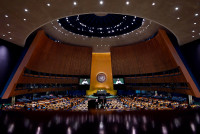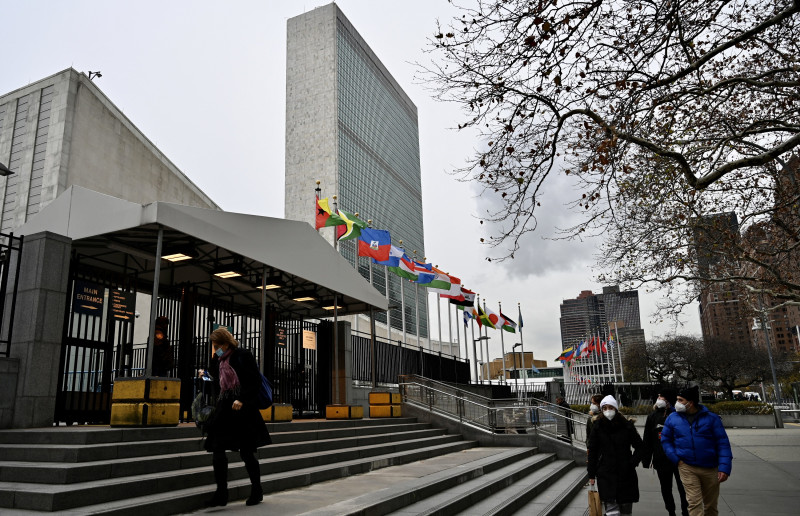
UNITED NATIONS – UN member states were still hard at work on Saturday morning (afternoon today in Malaysia) after a sleepless night spent trying to finalise a long-awaited agreement to protect the high seas, a fragile and vital treasure that covers nearly half the planet.
After more than 15 years of informal and formal talks, negotiators have reached the end of two new weeks of discussions – the third “final” session in less than a year.
But as of early Saturday morning in New York, participants were still wrangling over the highly political issue of benefit-sharing for research derived from marine genetic resources collected on the high seas.
“We do still have a few issues to clear, but it is making progress and delegations are demonstrating flexibility,” conference chair Rena Lee said around 1.30am (2.30pm Malaysia time).
Earlier on Friday night, Lee had said there was still “a window of opportunity to seal the deal, and we mustn’t let this opportunity slip through our hands.”
An updated draft text seen hours later by AFP did not contain the section on genetic resources, but appeared to be far from finished.
“It still has a lot of brackets in, which raises the question at this late stage of how they plan to go through it all,” said Nathalie Rey of the High Seas Alliance, a grouping of around 40 non-governmental organisations.
“But it’s clear at 4am, they are still really trying very hard to land the treaty today, otherwise they would have thrown in the towel.”
‘A massive step’?
Even if compromises are found on all the remaining disputes, the treaty cannot be formally adopted at this session, Lee explained on Friday in New York.
But it could be “finalised” without the possibility of reopening discussions on substantive sections, before a formal adoption at a later date, she added.
Even without adoption by Friday in New York, “It’s a massive step,” said Veronica Frank of Greenpeace.
Disputes include the procedure for creating marine protected areas, the model for environmental impact studies of planned activities on the high seas, and the sharing of potential benefits of newly discovered marine resources.
The high seas begin at the border of countries’ exclusive economic zones, which extend up to 200 nautical miles (370km) from coastlines. They thus fall under the jurisdiction of no country.
While the high seas comprise more than 60% of the world’s oceans and nearly half the planet’s surface, they have long drawn far less attention than coastal waters and a few iconic species.
Only about 1% of the high seas are currently protected.
Ocean ecosystems create half the oxygen humans breathe and limit global warming by absorbing much of the carbon dioxide emitted by human activities.
But they are threatened by climate change, pollution and overfishing.
North-South ‘equity’
For many, any agreement hinges on equity between the rich global North and poorer global South.
Developing countries, without the means to afford costly research, say they fear being left aside while others make profits from the commercialization of potential substances discovered in the international waters.
In a move seen as an attempt to build trust between rich and poor countries, the European Union pledged €40 million (RM190 million) in New York to facilitate the ratification of the treaty and its early implementation.
Delegates to a global conference in Panama on saving the world’s oceans also pledged US$19 billion this week, including US$6 billion from the United States and US$860 million from the EU for marine conservation.
Interviewed observers say that resolving these politically sensitive financial issues could help ease other sticking points.
If an agreement is reached, it remains to be seen whether the compromises made will result in a text robust enough to protect oceans effectively.
“The text is not perfect, but it’s got a clear path towards 30 by 30,” said Greenpeace’s Frank, referring to world governments’ commitment to protect 30% of the world’s land and ocean by 2030, as agreed in Montreal in December. – AFP, March 4, 2023